-->

July 25, 2023

Farming for cars

My dad, an inveterate driver, has made car trips across the width of the United States half a dozen times. At the end of the first day of their first trip, having started out from Boston, he called me and told me, with awe in his voice, that after driving all day they hadn't made it farther than Buffalo. 

Well, it's a big country.


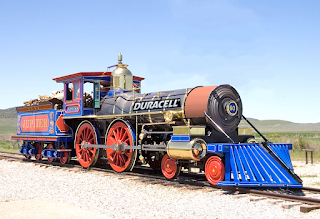
Photo by Don Graham under CC-BY-SA-2.0


The middle of the country is given to mostly one crop: corn. (That's maize to European readers). My mom, who liked to see interesting things on the way, was astounded by just how much land was dedicated to the growing of corn. She was also bored to tears. So on the next trip, she insisted that they go farther south. They never crossed the country as far south as Texas, but all up and down the midwest, they saw a lot of corn.

The US Midwest is blessed with the best farmland in the world, but humans' relationship with it is not that great: that land is regarded as a commodity, and is used for growing commodity crops. Like corn.

Here is a stat that blew my mind when I first heard about it: of the 80 million acres of corn planted in the United States, a lot goes into processed foods, more goes into cattle feed, but the single largest chunk of it, 45 percent, doesn't get eaten at all but goes to the making of corn ethanol. That ethanol is used as an additive to the gasoline you pour into your car's tank.

I am not making this up: it is the United States Department of Agriculture that says 45 percent of the country's corn crop goes into cars' tanks.

Such is the tyranny of the car that not only do people give up huge portions of the public space in cities to it, but also in the United States alone we sacrifice 36 million acres of prime farmland to feed it, or at least the version of the car that needs to burn stuff to move forward.

Which is a crying shame: because internal combustion engines are so incredibly inefficient that two thirds of that corn ethanol just gets wasted as heat. And where I come from there is a word for that kind of wanton waste: it's called a sin.

Think about it: two thirds of that good farm land is wasted. Two thirds of the water to irrigate the corn, thrown away. Two thirds of the fertiliser and the attendant runoff: for nothing. Two thirds of the fossil fuels burned for energy to work the land and process the ethanol: wasted. Speaking of energy: ethanol from corn yields only 1.5 units of ethanol energy for each energy unit used to grow it. Throw away two thirds of that, and you end up with half a unit of ethanol energy, that is, less energy than you put into the process. The word "insane" comes to mind.

The waste of farm land at this scale is the more unwise as extreme weather from human-made climate change makes it that much harder to farm food for people. India has suspended rice exports following catastrophic monsoon rains, even as Indian farmers grow huge amounts of sugarcane for car ethanol.

It doesn't have to be that way.

Imagine that, instead of planting corn, you install solar panels on that land, and used the electricity to power electric cars. An increasing number of people have imagined this, and some have actually done the math to do a miles-per-acre comparison.

The bottom line: An acre of land, if planted with PV solar, could yield 70 times more EV miles than corn ethanol from that same acre powering a combustion engine car. The number varies depending on who is doing the estimating and what assumptions go into their estimate, but a factor 70 is about the median value.

In Brazil and India where they plant sugarcane for car ethanol, the math works out about the same: 70 times more miles per acre if you use the same land for solar energy powering EVs.

This is awesome!

That is, this is awesome from an environmental and climate point of view. But does it make sense for farmers?

A group at UC Davis asked this question, then crunched the numbers. The answer is: Right now, the farmer can make a lot more profit with PV solar on their land, even when you include the installation costs. Farther down the timeline, it's complicated. Whether or not the farmer makes more profit from the solar than the corn depends on the wholesale electricity price, the initial costs to purchase, install, and connect the PV panels, and so on. A price on carbon would tilt the balance away from growing corn for fossil fueled cars. And of course, once everyone drives an EV the demand for corn ethanol would evaporate and its price would go down.

But an early adapter switching from corn to PV solar could really come out ahead. Sweeter yet, they could get into agrivoltaics, where you install PV solar on your land AND plant a crop in between the solar panels. It's like getting two crops from the same land, simultaneously. There is a symbiotic relationship: the presence of the crop cools the surroundings, boosting the PV yield, and the PV array gives partial shade which is beneficial for cooler-climate crops, and conserves water. Some solar panels are raised, and some can be tilted to vertical so that a tractor can access the area in between the panels.
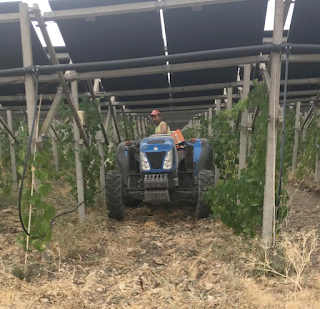

Agrivoltaic vineyard in Laterza, Taranto, Italy. Photo by Emilio Roggero under CC-BY-4.0

Best of all, even when all the EVs in the country are powered off solar PV where ethanol corn used to grow, there will still be plenty of land left. A farmer could choose to diversify their crops, as a hedge against extreme weather events. They could decide to re-wild some of their land and be paid for the carbon capture and ecological services. 

And driving through the Midwest won't be boring any more.

July 22, 2023

Energy efficiency: gasoline, electric, and hydrogen car

Imagine that you bought three pounds of vegetables, and immediately threw out two before starting to cook with the remaining pound.

Crazy, right?

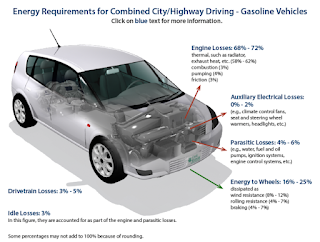
But something like that is exactly what you do every time you put gas into your car's tank: about 70% of the energy in the gasoline gets wasted as heat, and only 30% is put out by the engine to move things.


Where the energy goes in a car, froman interactive graphic at fueleconomy.gov

But it gets worse than that: There are mechanical losses at every step of the drivetrain from things like friction and inefficiencies. So in the end, only 16 - 25 % of the energy you poured into the gas tank goes into moving the wheels, and your car, forward. In the end, it's more like buying five to six pounds of vegetables to end up cooking only one pound.

Sounds like a rip-off to me.

For electric cars or EVs, a large range of efficiencies are quoted, but fuelefficiency.gov says EVs convert over 65 - 69 % of the electrical energy from the grid to power at the wheels, and if you include regenerative braking, where the energy from forward motion gets put back into the battery, that efficiency goes up to 87 - 91 %.

That's more like it!

I get that 9-13% of my vegetables could be peels, stems and other inedible parts, and I can live with not putting those in my cooking.

Incidentally, hydrogen cars are almost as bad as fossil fueled cars, efficiency wise. The electricity to wheels efficiency is only around 34 - 37 %. That's a little better than that of a car with an internal combustion engine, but it really can't compete with the efficiency of a battery EV. And if the hydrogen comes from the cracking of methane (also called "natural" gas) powered by a coal plant, then the hydrogen car is worse than useless from a climate point of view. Did I mention that hydrogen is a corrosive gas that attacks metals and causes cracks? And that it's highly flammable? Hydrogen cars are only a thing in the minds of fossil fuel directors who are hoping to keep selling their fossil gas.

That's why my next car will be an EV.


You may also like:


June 17, 2023

Battery powered locomotives

California is hard at work cutting carbon emissions. It has heeded the climate warning signs of drought, wildfires, and flash flooding and landslides, and is putting in place a serious climate action plan that reduces fossil fuel use in every sector. For this, it has deployed the California Air Resources Board, or CARB, whose acronym should be revised to "DECARB", as it now includes carbon dioxide and other greenhouse gases into the list of pollutants it needs to fight.

One way CARB is doing that is by telling railroads that starting in 2030 they are no longer allowed to use diesel locomotives that are more than 23 years old. Turning off the dirty diesel locomotives would save Californians $ 32bn in health costs.

You would think that the railroads would come back with a request for a huge chunk of money to help them modernise the rail network, and catch up with everyone else on the planet by making them electric. 

But no. The railroad industry is whining that they are already at work making their operations more climate friendly, that CARB doesn't have jurisdiction over the railroads, and that anyway there's no way battery operated locomotives will be ready by 2030 - because that's the only way they can imagine going electric. And because they are a big industry, the whining is done in a court of law.


I don't know about how railroads claim to be cutting emissions, nor do I know what jurisdictions CARB may or may not have, but I do know that battery operated locomotives are a solution looking for a problem. 

The idea seems to be deployed whenever someone wants to hold on to the past, that mythical and glorious past when a fleet of trains crisscrossed the United States running on coal-powered steam engines, on rails constructed right through indigenous peoples' lands, with total disregard for environmental and territorial issues.

The reason why e-cars and e-bikes need to run on batteries is that they can travel on myriads of roads, streets, alleys, and paths, not to mention off-road. A train however is confined to the rails, and right now there aren't that many of those, so equipping them with overhead wires is eminently doable. To use a battery for something that is catenary-ready is - a solution looking for a problem. 

It would also be an enormous waste of lithium, unconscionable at a time that we need all the lithium we can get to build batteries for those vehicles that are not confined to rails, like e-cars, e-motorcycles, and e-bikes, as fast as we can. For every locomotive battery that carries a whopping 7 MWh of energy, you can build 175 e-car batteries with 40 kWh each, or nearly ten thousand e-bike batteries carrying the typical  750 Wh.

The nation's rail network needs to be upgraded to accommodate high speed trains, and installing overhead wiring would be a relatively small addition to the cost. China is as vast as the United States and for years now they have enjoyed a high speed rail network running on overhead wires, so it's not like it's unproven tech. If you could cover Boston to Washington DC, or St. Louis to Atlanta, or San Francisco to Los Angeles, in three to four hours, you wouldn't take a plane (those are not about to get decarbonised, either, no matter what airline CEOs say).

The US railroad industry's diesel engines are only one step up from the pre-war coal-powered steam engines. It's time for US rail to come into the twenty-first century.

May 18, 2023

Norway's new tack on the EV

For some time now, Norway has been the darling of EV advocates. Article after breathless article will detail how electric cars make up a larger and larger percentage of cars sold in the country. 

But nobody asks how that is done. 
You would think that EV enthusiasts would give a detailed report on HOW the Norwegians got to drive all those EVs, but you would be disappointed. And that's too bad, because Norway is a case study for how to transition to EVs in little more than one car generation.

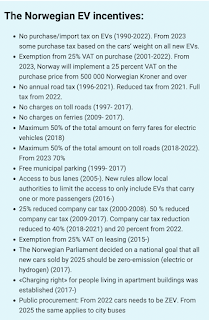
The recipe is really quite simple: the Norwegian government sweetened the deal for owning an EV so much that if you were sentient at all, you would be gripped by FOMO, the fear of missing out on all those goodies. For starters, buying an EV gave you huge breaks on a vast array of auto taxes, from the import tax, to the VAT, to the annual road tax. Toll roads and ferries were free for EV drivers. Heck, municipal PARKING was free (until 2017). If that doesn't give a driver FOMO I don't know what will. 

You can gape at the full list of incentives below, I've reproduced it here from the Norway EV Association's website (which is in English, helpfully, and maybe also to give the rest of us outside Norway an acute case of FOMO).


No wonder that by 2021, 86% of cars sold in Norway were electric. 

You would think that Norwegians would now sit back, shout "Ska!", and down a glass of aquavit, for having arrived at the electric future. But no. Not content with having one-upped the entire world in EV penetration, Norway is now taking the next step. Seems their new motto is, 

We don't need newer cars,
We need fewer cars.

The Norwegian transportation minister has said Norway will focus on making it more attractive to walk, bike, and take public transit.

They didn't start this recently, this shift has been in the works for quite some time. If you look over the list of incentives, you will notice that a number of them are being phased out. For instance, toll roads were free to EV drivers until 2017, but starting in 2018 they paid half the toll, and starting 2023 it's 70% of the toll. This makes sense: once everyone starts to buy an EV, the FOMO ploy doesn't work so well any more. Also it gets expensive.

So starting next year, Norway is going to re-introduce the VAT, and in a progressive way, that is, the more expensive the car, the higher the VAT rate. This will have the effect of discouraging the sales of all EVs, but especially that of larger, more expensive EVs. Having fewer large and heavy vehicles will make streets safer for pedestrians and bicycle riders, in line with the country's Vision Zero policy.

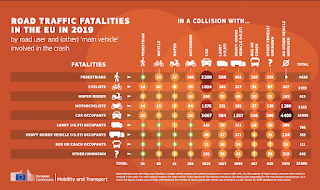
In the capital, Oslo, the Vision Zero policy has resulted in zero traffic deaths in 2020. They achieved this stunning success by building out safe pedestrian and bicycle infrastructure, but especially by reducing the number of cars on the streets. Noway wants zero traffic deaths in the whole country, and reducing the number of cars everywhere will go a long way to achieving that, because car drivers are the cause of the majority of traffic deaths.


This graphic shows who dies in traffic on European roads in 2019, and who caused those traffic deaths. Data from the European Commission.


CelloDad says the Norwegian government is manipulative. Of course they are. But corporations also manipulate you, through their ads, only they do it mostly for the purpose of selling their stuff to you. If Norway's government uses incentives to nudge Norwegians into doing the thing that is right for their health, for the planet, for the health of their communities, then more power to them. Note that they didn't ban the sale of gas or diesel cars (they will do that in 2025); they merely made EVs irresistible. 

Let's see how long the rest of us take to catch up with them.


August 10, 2022

This EV uses a tiny amount of lithium in its battery

Now that the EV revolution is underway, and car manufacturers are starting to electrify their lineups in earnest, suddenly there is a lot of hand wringing over the lithium supply. Lithium is a key ingredient to the batteries that most EVs run on, and like everything on this planet, there's a finite amount of it.

The average electric car needs about 8 kg of lithium in its battery. So as EV production accelerates, soon the industry will reach the point where the rate of EV production is limited by the availability of lithium.

Meanwhile, global heating is proceeding. Already in this northern-hemisphere summer of 2022 we're dealing with extreme high temperatures, deepening drought or flash drought, extreme rainfall, just weirdness all around,. All that while we're only at 1.2C warming, well below the 2C limit set in the Paris climate accord. We need to stop carbon emissions, and we need to do it fast.

So a bottleneck in electrifying our transportation is something we don't need right now. But it doesn't have to be that way.

It's time to look outside the box. A steel box with four wheels is what we tend to think of when we hear "EV". But what we need to decarbonise is not cars; but the transportation of people. If you think about it that way, that opens up a whole new world of solutions. Think of the train, which has a lot more than four wheels, all steel.

Then there's the EV with two wheels, better known as the e-bike. I know, bikes are not for everyone. Hey, neither are cars. But we are considering here how to move people, and both bikes and cars move people. (And let's face it, most cars get used by a single person, the driver, most of the time).

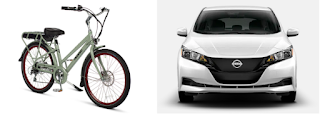
So let's try this: let's do an EV comparison with a twist: let's compare the Nissan Leaf and the Pedego City Commuter. Both are utilitarian vehicles, both run on a battery, and both can be used to get yourself to work or to your errands. For both, we look at the version with the higher range.


The Nissan Leaf with a range of 212 miles has an electric motor of 214 HP powered by a 60kWh lithium-ion battery. Its effective efficiency is 121 MPGe, the electric equivalent of the miles per gallon number we're familiar with.

Now let's take a look at the Pedego City Commuter. Its range is only 60 miles. This is not as impractical as it sounds, as its speed is capped at 20mph; most people would not use a bicycle for a commute that's more than 20 miles, anyway. 

Because it has a lot less mass to propel, its pedal-assist is powered by a 749W motor. In horsepower-speak that would be - drumroll - 1 HP. One horsepower. I mean, that's  just adorable.

That single horsepower comes out of a battery with a capacity of 720Wh: also itty-bitty compared to car batteries that are measured in kiloWatt-hour (kWh) units. But for the purpose of cutting carbon fast, small is not only adorable: it is positively awesome. Why? To begin with, this EV has an efficiency of 2853 MPGe. But more importantly for speeding the transition, it takes a minuscule amount of precious lithium to build this battery.

Suppose that it takes the average 8kg of lithium to make the Nissan's battery with its 60kWh capacity. Assuming that there is a linear relation between the amount of lithium in a battery and its capacity, this means that the bicycle battery (0.72 kWh) needs - another drumroll - 96 grams of lithium. (If you don't speak metric: that's 17 pounds of lithium for the car battery versus 3.4 oz for the bike battery).

For the lithium it takes to build a single car battery you can build more than 80 bicycle batteries.

I'm of course not saying that this will move the electrification of transportation ahead 80 times faster. As we've agreed, the bike is not for everyone. But if you do bike, an electric bike is more fun, it's faster, it gets you where you're going without a sweat. E-bikes are much cheaper to buy and operate, don't require the additional expense of insurance, and don't require a driver's license. Should the battery ever run out during your trip, you're not stranded, you can still pedal home. These are all reasons for riding your e-bike farther and more often, and leaving your car at home.

In the early days of mobile communications, people had cell phones in addition to their landlines. But over time lots of people gave up their landlines altogether. It could be like that for e-bikes and e-cars. People might dedicate their garage to the family e-bikes, and rent a car when the occasion requires - electric, of course.


You may also like:


August 9, 2022

Inflation Reduction Act

Summer 2022 has brought home the idea that the summer season is now the danger season. It seems like the entire northern hemisphere is experiencing extreme heat, or flash drought, or wildfires, or extreme rain and flooding - and all this even though it's been a very quiet hurricane / typhoon season so far.

So the passage of the cleverly named Inflation Reduction Act by the US Senate is welcome relief amid the multiple ongoing crises which I won't enumerate here: You know what's keeping your brows furrowed.

It is a welcome thing that a lot of the initial coverage of the IRA has been about the money savings for ordinary American families, in their energy bill and when they are ready to buy an electric car, for instance. More of them need to start talking about the jobs this will bring: lots of jobs, with good benefits.

The bill is not perfect. And it still needs to get through the House. It is still susceptible to intense lobbying, both from the corporations who stand to lose profits, as well as the rest of us who prefer a livable climate. But the fact that it passed the hurdle of the divided US Senate is significant. US climate action is finally catching up to the other developed countries, and that's worth celebrating. 


February 13, 2021

Cop Shows Without Car Chases

One year into the COVID-19 pandemic, we've learned more about virus biology than we cared to know; done more zoom meetings than we wanted to sit through; learned that, when society gets turned upside down, a few ugly things come to light; re-discovered our bikes; and binge watched shows. It's been quite a year, and the lucky ones among us have spent much of that year at home.

Like many others, I discovered Korean tv shows. It's like going on a holiday, but from your own couch: you get to struggle with the language, even if only passively, and learn about the culture a little bit.

It's different. For starters, people address each other by their full names, family name first. It's a change from Japanese shows where characters address each other by the family name only. But I suppose in a place where there are only so many last names you have to add the given names - I am told that the Korean version of looking for a needle in a haystack is "looking for Mr Kim in Seoul".

It seems Asians in general have only recently discovered the kiss. They don't even have their own word for it, apparently: in Korean romantic comedies they use the English, "kiss" (pronounced "kis-su"). You can tell it's novel because a kiss tends to be shown with a dramatic sweep of the camera, and usually at least three times, from different angles. At first it takes you by surprise, then it's hilarious.

Scene from Tunnel, in which the very manly main characters both cry often.

There is this myth around of the inscrutable Asian, but many Korean shows depend on the close-up; the changes in facial expression carry the emotional story of the show. One of the important emotions is sadness, and Korean characters of both sexes show that, by crying. In Mystic Pop-Up Bar the stories revolve around the dead, so it's unsurprising that there's a crying man in just about every episode. But even cop shows (The Good Detective, Tunnel) feature men who are man enough to cry.

The product placement is shameless. I'm clueless about Korean brands, but learning fast because you just can't not see it. And you can't miss the placement of western brands, like when every one of the main characters in Itaewon Class starts driving a Mercedes.

Fights are different too. The typical Western hero hardly ever suffers a beating, but when he does take a hit, he bounces right back up, every hair in place, to deliver the retaliatory blow. Asian characters don't have that kind of teflon: one hit on the jaw (sometimes not even on the jaw) and there's blood on the lips. Fights don't look clean at all, they're more like scuffles, and somehow feel more realistic.

Scene from Stranger, where the getaway vehicle is a bicycle, subsequently discarded as the culprit jumps over a balcony. The cops in hot pursuit are, of course, on foot.

Here's another feature that you can't miss: Korean cop shows have no car chases. Occasionally there is one, but in most chases, the culprit tries to get away by jumping over walls and sprinting down ways barely wide enough for two bicycles to pass each other, let alone a car. Shows set in Seoul also tend to have chases on very hilly streets. The music is pumping, your heart is pumping, but instead of the cop or the culprit shown madly turning the wheel or - in European chases - gamely changing gears, this chase is all about whose lungs and legs win out. It's cool and refreshing!


You may also like: 1. Measuring Loss in Terms of Human Suffering, Not Dollars 2. The Car as Apocalypse Meter: Bread Line 3. Why Bicycle Riding Is Good For Democracy


February 9, 2021

EV: no catalytic converter required

Superbowl 2021 featured an ad for GM's EVs. It's got Will Ferrell, Kenan Thompson and Awkwafina traveling – separately, getting lost in different countries – to see what's up with Norway's success in getting electric cars on the road, and how come they're ahead of the United States.

Spoiler: as Robinson Meyer points out, "EVs command 54 percent of the market share in Norway not because Norwegians love Tesla, but because Norway has thrown a small fjord’s worth of incentives and mandates behind them."

I suppose if you're GM, you don't want to remind anyone that until quite recently you threw your considerable clout behind fighting federal mandates that would promote EVs. You focus on the made-in-America thing, the patriotic thing, the masculinity thing, even if what we're talking about here is electro-masculinity.

I want to see an ad that makes fun of the fossil-fueled, horsepower worshipping masculinity. Pitting, say, a mom bringing her kids to soccer practice without mishap in her EV, against her neighbour with the gasoline powered muscle car who gets stuck in his driveway because his catalytic converter has just been swiped for the precious metals it contains. The tag line for the EV: "No catalytic converter, no tears".

As catalytic converter theft has been rising dramatically, people would recognise the consternation you feel at realising that you can't get ouf of your driveway. Not to mention that it takes upwards of two thousand bucks to get your gas-driven vehicle to carry you around again. In contrast, an EV has no tailpipe pollution, so it doesn't need a catalytic converter.

The irony is that the Prius, that symbol of the clean drive (before EVs came along that is), is one of the cars most vulnerable to losing its catalytic converter to theft. My brother finally had to let go of his twenty year old Prius, after the second time its catalytic converter was stolen. The catalytic converter is just about the first thing you see when you crawl under a Prius; also it's shaped like a tardigrade so it's irresistibly adorable.


No wonder people are now selling covers that make it harder to take off the catalytic converter.


You may also like: 1. Measuring Loss in Terms of Human Suffering, Not Dollars 2. How to buy a gas sipper for less 3. Extreme weather and the migration of drivers' licences


April 12, 2020

The Car as Apocalypse Meter: Bread Line

In the United States of the late 20th century and the beginning of the 21st, the car is ubiquitous. It dominates the roads. It makes its presence known. We know its speed, its smell, its size.

And that is why the car is used as a yard stick to measure things by. In a disaster, the car is used to convey the scale of that disaster in terms most people can understand. Think of the image of the yellow taxis in New Jersey, submerged in muddy water halfway up the windows following superstorm Sandy.

The coronavirus pandemic has brought lockdowns, and the lockdowns have brought traffic to a halt all over the planet. People are gushing over the long-range views, the blue sky - "Positively Alpine!" -in places that usually choke in deadly air pollution, the silent killer we have learned to live alongside, more of less successfully ignoring its fatal effects.

The absence of the car is disconcerting, gives freeways and thoroughfares a funereal, apocalyptic feel. Instead, we find the car re-arranged in new formations.

On April 9, 2020, the San Antonio Express News published an article on the line that formed at the San Antonio Food Bank. In the old days, breadlines were lines of people. The scale was human, and this is what made an impression. But the bread line of 2020 is a line of cars.

People queued up in their cars to preserve the physical distancing that limiting the spread of the virus called for. In San Antonio there were 10,000 cars lined up, its drivers waiting for hours to receive food after they had been laid off in the vast shuttering that had taken place throughout the country.


The number 10,000 is just a number. But an aerial photo of the cars, lined up in orderly rows, brings home just how many people were collecting that donation of food, on that hot day in Texas.

And I wonder what happened to the people who needed food but didn't have a car.


You may also like:
1. Measuring Loss in Terms of Human Suffering, Not Dollars
2. How to buy a gas sipper for less
3. Extreme weather and the migration of drivers' licences


August 10, 2019

Equity First

We humans have a fine nose for fairness, or lack thereof. Even before they learn about fractions in school, children can tell whether or not a pie is equitably divided. So if you're trying to propose a plan that makes things less equitable, you'd better have a convincing story.

Reagan's "A rising tide lifts all boats" was one of those stories. The 1980s rang in an era of rising inequality not seen since the Roaring Twenties.

This is true globally as well: the global version of Reagan's story was that globalisation would lift all boats, including those in developed countries. It did work out that way, but only for selected countries, like South Korea. In general, globalisation has caused the playing field for the accumulators to expand, so that now a handful of people - 26, to be precise - owns literally half the wealth in the world.

What did the rest of the world get out of it?

August 6, 2019

Low-Carbon High Rise Buildings? Bring It!

The skyscraper was the twentieth-century symbol of power and success, forming the highrise jungle of successful cities like New York, and copied in Hong Kong, Sao Paulo, Dubai, Kuala Lumpur, Beijing, and a long list of cities arriving into the fast growing global club of movers and shakers.

Most modern skyscrapers are of the steel-and-glass construction pioneered by the architect Mies van der Rohe. Here's one example: the building that houses the Department of Electronic Engineering, Mathematics and Computer Sciences at the University of Delft.

Its still a handsome building to look at. But its windows, facing east and west, catch the sun very efficiently and turn the place into a giant greenhouse. A very long time ago, as a physics freshman, I used to take an introductory electronics lab on some high floor on afternoons, but nobody ever enjoyed the view as the teaching assistants always kept the shades down and closed as tightly as possible. Even so, I sweated over those labs, and not just because I wasn't all that good at electronics.

As it was a fall course I never did find out how the building did in winter, but since it was constructed before double-pane windows were a thing, my guess is it could get pretty cold on the side that was not in the sun, which was at least half the place.

What I'm getting at is that climate control in this type of building is an energetic nightmare, even in the kind of temperate climate Mies van der Rohe hailed from. I shudder to think of the carbon footprint required to keep highrise livable in places that get cold, like Toronto, or that get super hot, like Dubai.

Yet here is New York, a place that gets both cold winters and hot summers, whose climate action plan calls for its buildings to cut their carbon footprint by 40 percent by 2030, which is only a decade away. On the other side of the continent, Vancouver's glass towers are said to undercut the cities nice climate action plan.

What to do?

August 2, 2019

Holiday Travel in the Age of Climate Change

When I was growing up, come the summer holidays my parents would pile our stuff in the VW van that my dad had converted into a camper, and drive around Europe for four to six weeks. They always took care not to leave on the vacation rush: that weekend when half the Netherlands seemed to start their holidays, and highways to sunnier destinations could be congested for literally hundreds of miles.

In fact, "Black Saturday" is still a thing. It's on today for France, where there is a warning out not to travel unless you really have to, especially on the roads around popular destinations like Bordeaux. There's a total of 800 km (500 miles) of stuck traffic on French highways.

These days, vacation travel is hard for other reasons as well. A few years ago, we had to cancel a trip due to heat: I had been watching the weather forecast at our destination, and each day in the week before our departure the predicted temperature kept rising. The night before we were to get on the train, the forecast called for 38C (100F) temperatures.

Reader, we cancelled the entire trip.

We were lucky that our reservations were refundable (except the first leg of the train, as we made the decision within 24 hours of departure). Since then, we've made sure that our holiday reservations are of the cancellable type, even if doing that costs more.

This summer, that really worked out. Temperatures were coming down after two heatwaves that hit western Europe hard. Things were looking good. But then, a few days before our departure there was an intense, record-breaking heatwave. We took my aunt to cool off at Ikea, and started watching the weather and the travel advisories.

Rail operators started to report trouble on the lines: there were disruptions in the electricity supply or mechanical issues. Thalys, the high-speed operator, was briefly even forced to close ticketing.


This is travel in the era of the climate crisis: you need to monitor whether you can actually make that trip. We cancelled our hotel reservation. We discussed flying, but only briefly. My family knows I'm, putting it mildly, not in favour of short haul flights. Anyway, flights were being disrupted by thunderstorms at our destinations, so that was that.

In the end, on the morning of our departure we made a decision to take a chance, and we did make it without delays and without getting trapped in a hot train car. We made hotel reservations from the train (yay for WiFi on the rails!) Then we had a good time exploring, using the local public transport cards. We haven't had a car vacation in years, and don't miss sitting in the kind of holiday traffic that's out there today.


You may also like:
1. Why I Love High-Speed Trains
2. My Big Fat Dutch Wedding
3. How Will You Travel for Thanksgiving?


July 12, 2019

Is the Flying Dutchman a Myth?

Of course the flying Dutchman ship is a myth. But I'm talking here about today's average flying Dutch person.

But that word "average" contains a thousand pitfalls: in a recent column, Tim Harford points out that there is no such person who is the "average" person. In talking about populations, the average tells you something, but is far from the complete picture.

The distrbution is the important thing.

One - rather extreme - example is that of the United States, which is said to be one of the richest countries in the world but has plenty of citizens who go to bed hungry.

Meaning, the "average American" is a myth.

So it comes as no surprise that the "average American eater" is also a myth. A recent study has shown that only 20% of Americans are responsible for 46% of American's food-related emissions. This would be the 20% who eat a lot of beef and dairy.


Infographic by Sara Chodosh

July 7, 2019

Why Bicycle Riding Is Good For Democracy

"Which way shall we go?" says CelloDad.

There's no question where we're headed: to the Market Square in Delft, the Netherlands, which hosts the City Hall where we were married all those years ago. But today we were headed to have pancakes at one of Delft's many find establishments.

When we borrowed my dad's car, we would not have sweated the question. I would be at the wheel, and we went however I decided to go, and that was that.

But we're on bike, and that changes everything.

From my dad's place, it takes less time to reach the market square by bike than by car, and you don't have to pay the horrendous parking fees. But it takes negotiation, because there are lots of ways to reach downtown by bike.

May 28, 2019

Dutch Public Transit Strike: Absence Makes the Heart Grow Fonder

Dutch public transit services went on strike today over a disagreement on the retirement age (which is set to rise to 67 years and then to track the life expentancy).

And this is how you find out just how good the Dutch public transit is: when it gets taken away for a day. A million people (out of a population of 17 million) depend on it to get to work or school. It is used by a broad section of Dutch residents (unlike in the United States where, outside a few coastal cities, trains and buses are occupied mostly by the poor and by hapless foreigners).


Photo by Yintan

As one example: Arriving at Schiphol airport generally involves going through immigration, picking up your luggage, and rolling it straight downstairs to the train tracks: the railway station is an integral part of the airport. On weekdays it's serviced by 25 trains per hour.

It's no wonder that the union action struck fear and panic among the operators at Schiphol. If all their passengers arrived or left by car it would be total chaos. They sued for retention of train service. A judge granted the exception, and today air travelers can expect 4 trains every hour at Schiphol.

May 13, 2019

Fossil Fuel Subsidies Far Higher than Companies' Profit.

This is a bold claim to make, and one that you might expect from radical groups like Friends of the Earth or Greenpeace. But it came from that staid, wholly establishment organisation, the International Monetary Fund.

The IMF estimates that in 2017 global fossil fuel subsidies reached a mind-blowing 5.2 trillion dollars, or 6.5 percent of global GDP, up from $4.7tn in 2015.

These costs include not only direct subsidies but also tax breaks that dinimish national budgets, health care costs from fossil fuel related pollution, the cost of traffic congestion, and so on. It's a pretty thorough assessment of all the indrect costs to society.

Worldwide subsidies for coal is about $2tn, subsidies to oil and gas about $2.5tn.


Now here's the truly gobsmacking thing about all this:

March 15, 2019

#SchoolStrike4Climate: Why I've been quietly crying

As is the way with worldwide events, New Zealand and Australia took the lead on the School Strike for Climate. Young people skipped class and took to the streets by the tens of thousands. I watched them from fourteen time zones away.


They came out in mountains, by rivers and in cities.


They walked in sunshine and steady rain, in grassy fields and by stately cathedrals

March 10, 2019

What do YOU see in the Green New Deal?

Let's start with a related question: how often do you talk about climate change, with your family, your friends, your colleagues, people at your place of worship? On a personal level, the single most important thing you can do about climate change is to talk about it. This has been the long time advice because with climate change, like with AIDS, silence kills.

Generally, we find it hard to talk about climate: it's like talking about cancer. It puts a damper on parties and convivial meals. So we tend to avoid the topic.

Two developments in late 2018 have changed that, completely.

The smaller thing is a poll from the Yale climate change communication group, that shows that for the first time more than half of Americans are worried about climate change: six in ten, to be precise. And nearly a third of Americans are very worried, or "alarmed" as the label goes.

This means that if you approach a total stranger, they are more likely to be worried about climate than not. Exactly how likely you are to find a like-minded person depends on where you live. But the fact remains that there has been a shift in sentiment from "it's a hoax" and "who cares", more toward "yes, I'm worried".

But what has really put climate change on the national discussion table is the emergence of the Green New Deal. Championed by the Sunrise Movement, young people who don't take no for an answer and lobby their elected representatives hard, it has earned the support of the charismatic young representative from Brooklyn, Alexandria Ocasio-Cortez.

In a way, the American right has fallen into the Trump trap. In the same way that the left, outraged by the lies in the president's tweets, are complicit in keeping those lies circulating, so now the right keep AOC and her progressive ideas in the news by compulsively trying to take down both her and her proposals.

Of course, the entire American punditry on the left is also jumping into the discussion, and suddenly everyone is talking about climate action.

But not everyone gets the Green New Deal right.

March 6, 2019

I'm Back

The biggest advantage, and the biggest disadvantage, of being an independent blogger is that you call your own time. This means that when life offline demands your attention, the blog goes by the wayside. That is what happened for the past year or two.

Now that I'm back, I'm going to write more about climate solutions, and maybe more outside the box with four wheels on it.

Not that I will stop writing about cars altogether. After all, a new and exciting wave of electric vehicles are just over the horizon, and, now that my kids have learned to drive with a stick, eventually we will need a replacement for that diesel Golf that we are driving now, so I'll be looking into those EVs.


Photo by Hans Weingartz

There will be no more posts on diesel cars. Europe made a pact with the diesel devil: they were going to put up with the particulate matter pollution for their population, in exchange for the very high efficiency that diesel offers, and a way to cut carbon emissions. Well, the diesel devil did what devils usually do when you make a pact with them, and after dieselgate one European country after another is now pledging to phase out the sale of all internal combustion engine cars, and to transition to electric ones. Who am I to buck that trend?

The sun rises on the EV.


You may also like:
1. Can you trust MPG specs?
2. How to buy a gas sipper for less
3. How much horsepower do you need?


December 14, 2018

Mainstream news and the elusive truth

When Jeremy Clarkson appeared on the automotive scene, he was a breath of fresh air. He said it the way it was. He made a name for being the bad boy of car reviewers, and he often had a point. Loads of people read his pieces, because they were funny, and different from the polite (=boring) reviews that were the norm.

But all that happened in a distant past that is as gray as Clarkson's hair is now. As he became more famous, the reviews started to lose their edgy feel. In 2002, Clarkson became the host of a wildly popular tv show, Top Gear. It had sponsors.

And that, really, was the beginning of the end.

Because it's okay for a kick-ass upstart car journo to make snide comments about the car you were reviewing. But if you're too controversial on a large-following show, your sponsors might balk. Worse, they might walk out on you. If you believe this has zero bearing on how a man presents his show, I've got a bridge to sell you.

I mean, it's okay for a CelloMom to compare a Lexus SUV to a pregnant Honda Civic, or to remark that to me, seeing the 2019 Mercedes GLC brings to mind the word "obese", and prompts a mental note to eat less -- but I'm just a lone blogger writing on my own time, sponsored by nobody and answering to none but my own demons.


Photo by Daniel Blume

And this is why we all need to look critically at our news sources. I'm not talking about the fake news of Fox (which is not a news outlet but a propaganda machine). I'm talking about the "mainstream" media, the well-respected shows and dailies, the ones you don't mind name-dropping.

Let me give an example. Because I think and read about climate change a lot, I have learned that social equity is inextricably linked to the issue of climate. So I'm foraying into a rich and diverse world of writings by people who are not "my" people. I'm painfully wrapping my head around economic issues, for instance, a departure from the science articles I'm familiar with. But going beyond that, I'm also reading pieces written by Black people, feminists, indigenous people, socialists, and others who are somehow outside the "mainstream". It's not always comfortable reading, but I think it's essential. For one, I'm discovering - okay, I'm a geek, but DUH - that "mainstream" America is white. It tends to live in large cities, tends to be pretty well off, or anyway well enough. And it is blind to the experience of everyone who is outside its own relatively small demographic.

I've been thinking about that saying attributed to the Cheyenne: "Don't judge a man until you've walked two moons in his moccasins". That makes sense: "don't judge". But what about writing? After all, we each write from our own perspective, and that perspective is shaped by who we are. Merely interviewing someone will not make you truly understand what they're saying, because there is a rich, deep, and quite invisible set of layers underneath, of personal, family, and social history and meaning, and the words they are saying are built on all that richness. Some things you wouldn't even think of writing about, simply because they are outside your sphere of experience.

So I'm exploring more. While certain news outlets can be relied on to produced solid reliable pieces, and I support more than one with my subscription dollars, I am also looking to follow particular authors, people I find I can learn from in every article. These days, I read Hiroko Tabuchi, John Sutter, Pilita Clark, Noah Smith, Simon Kuper. But also Kate Aronoff, David Graeber, Angie Schmitt, Emily Atkin, David Roberts, Umair Haque, Thea Verkade, Rebecca Solnit. And Caitlin Johnstone, who got me thinking about all this with her article on how mainstream media follows the establishment agenda. I am enlightened by their writing, delighted, angered, surprised – and humbled; certainly I am enriched.

This is a choice that is ours to make. Here is another example: Facebook, Twitter, and other social media platforms like to present you a timeline that is determined by their algorithms to be "most interesting" to you. But I have found that the algorithms invariably give me a narrower and narrower view of the people I follow, and that I end up walking the same deeply grooved paths over and over. Not to mention vulnerable to manipulation. But when I over-ride the algorithm and make my timeline show everyone I follow, the timeline is much more lively, and interesting. Because hey, those people were chosen by me, not by an algorithm written by a team of geeks who are certainly not me.

Try both: let your timeline reflect your true interests. And let your mind be widened by thinkers and writers who are not in the mainstream. It may take you out of your comfort zone. And that is where growth happens.


You may also like:
1. Can you trust MPG specs?
2. How to buy a gas sipper for less
3. How much horsepower do you need?