-->
Showing posts with label frugal. Show all posts

August 10, 2022

This EV uses a tiny amount of lithium in its battery

Now that the EV revolution is underway, and car manufacturers are starting to electrify their lineups in earnest, suddenly there is a lot of hand wringing over the lithium supply. Lithium is a key ingredient to the batteries that most EVs run on, and like everything on this planet, there's a finite amount of it.

The average electric car needs about 8 kg of lithium in its battery. So as EV production accelerates, soon the industry will reach the point where the rate of EV production is limited by the availability of lithium.

Meanwhile, global heating is proceeding. Already in this northern-hemisphere summer of 2022 we're dealing with extreme high temperatures, deepening drought or flash drought, extreme rainfall, just weirdness all around,. All that while we're only at 1.2C warming, well below the 2C limit set in the Paris climate accord. We need to stop carbon emissions, and we need to do it fast.

So a bottleneck in electrifying our transportation is something we don't need right now. But it doesn't have to be that way.

It's time to look outside the box. A steel box with four wheels is what we tend to think of when we hear "EV". But what we need to decarbonise is not cars; but the transportation of people. If you think about it that way, that opens up a whole new world of solutions. Think of the train, which has a lot more than four wheels, all steel.

Then there's the EV with two wheels, better known as the e-bike. I know, bikes are not for everyone. Hey, neither are cars. But we are considering here how to move people, and both bikes and cars move people. (And let's face it, most cars get used by a single person, the driver, most of the time).

So let's try this: let's do an EV comparison with a twist: let's compare the Nissan Leaf and the Pedego City Commuter. Both are utilitarian vehicles, both run on a battery, and both can be used to get yourself to work or to your errands. For both, we look at the version with the higher range.
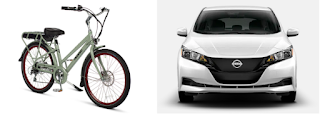


The Nissan Leaf with a range of 212 miles has an electric motor of 214 HP powered by a 60kWh lithium-ion battery. Its effective efficiency is 121 MPGe, the electric equivalent of the miles per gallon number we're familiar with.

Now let's take a look at the Pedego City Commuter. Its range is only 60 miles. This is not as impractical as it sounds, as its speed is capped at 20mph; most people would not use a bicycle for a commute that's more than 20 miles, anyway. 

Because it has a lot less mass to propel, its pedal-assist is powered by a 749W motor. In horsepower-speak that would be - drumroll - 1 HP. One horsepower. I mean, that's  just adorable.

That single horsepower comes out of a battery with a capacity of 720Wh: also itty-bitty compared to car batteries that are measured in kiloWatt-hour (kWh) units. But for the purpose of cutting carbon fast, small is not only adorable: it is positively awesome. Why? To begin with, this EV has an efficiency of 2853 MPGe. But more importantly for speeding the transition, it takes a minuscule amount of precious lithium to build this battery.

Suppose that it takes the average 8kg of lithium to make the Nissan's battery with its 60kWh capacity. Assuming that there is a linear relation between the amount of lithium in a battery and its capacity, this means that the bicycle battery (0.72 kWh) needs - another drumroll - 96 grams of lithium. (If you don't speak metric: that's 17 pounds of lithium for the car battery versus 3.4 oz for the bike battery).

For the lithium it takes to build a single car battery you can build more than 80 bicycle batteries.

I'm of course not saying that this will move the electrification of transportation ahead 80 times faster. As we've agreed, the bike is not for everyone. But if you do bike, an electric bike is more fun, it's faster, it gets you where you're going without a sweat. E-bikes are much cheaper to buy and operate, don't require the additional expense of insurance, and don't require a driver's license. Should the battery ever run out during your trip, you're not stranded, you can still pedal home. These are all reasons for riding your e-bike farther and more often, and leaving your car at home.

In the early days of mobile communications, people had cell phones in addition to their landlines. But over time lots of people gave up their landlines altogether. It could be like that for e-bikes and e-cars. People might dedicate their garage to the family e-bikes, and rent a car when the occasion requires - electric, of course.


You may also like:


May 13, 2019

Fossil Fuel Subsidies Far Higher than Companies' Profit.

This is a bold claim to make, and one that you might expect from radical groups like Friends of the Earth or Greenpeace. But it came from that staid, wholly establishment organisation, the International Monetary Fund.

The IMF estimates that in 2017 global fossil fuel subsidies reached a mind-blowing 5.2 trillion dollars, or 6.5 percent of global GDP, up from $4.7tn in 2015.

These costs include not only direct subsidies but also tax breaks that dinimish national budgets, health care costs from fossil fuel related pollution, the cost of traffic congestion, and so on. It's a pretty thorough assessment of all the indrect costs to society.

Worldwide subsidies for coal is about $2tn, subsidies to oil and gas about $2.5tn.


Now here's the truly gobsmacking thing about all this:

June 9, 2018

Three Ways to Lower Your Car Payment

In the fight about affordable housing, which seems to rage everywhere, it is often forgotten that it's not only the price of the house that needs to be considered, but also everything else that comes with home ownership, like the real estate tax rate, and the heating costs. One large expense post that tends to get overlooked is whether or not you need a car to get to and from your house.

This spring, the average price of a car in the United States reached $34,000, up from about $30,000 only six years ago. And because interest rates are up, the average monthly car payment is now $535. That's before the insurance and the fuel. Who can afford that? Not, in turns out, the typical family.

Those who live where the public transport is good, don't need a car. But if you must have a car (like, to get to the job that pays for the loan of the car that you need to get to the job), there are a few tricks to make it hurt less.

1. Get the smallest car you fit in for everyday use
Be honest with yourself about what you really need: if you're a couple with a toddler, you don't need the minivan or the SUV. For the occasional grandparents' visit, rent a minivan: unless they visit every week, that will be less expensive than owning one (and even cheaper if the grandparents rent one!).

2. Get the smallest engine you can buy for your chosen car
Dealers like to tout the "benefits" of a large engine. Take their sales pitch as just that: a sales pitch. The real benefits are to their bottom line. You don't need 220HP to get yourself around town; that sort of horsepower only feeds into racing car fantasies. A smaller engine costs less at purchase, and less to feed.

3. Good things come to those who wait.
In this case, cheap things. US car dealers like to sell you from the stock they have on their lot. They have already paid for this stock and they want to move it as quickly as possible. This means that you buy whatever they think "most people" will buy. But if you have time to wait, you can really make out.

Here's what you do: You order your car from scratch: the bare car. Then you add only the features you like or need, and no more. Buying a car this way is cheaper because it doesn't come pre-loaded with features like most dealer-lot cars. All those features may be "standard" - but they are not free! You may have to persuade your dealer that they will do this for you. And you do have to wait a few months (depending on how far away your car is manufactured) but then you get the car to your exact specifications: If you want leather seats but not air conditioning, you can have that. This is how most cars are still ordered in Europe.

My current car was delivered with larger wheels. I didn't want larger wheels, which lower the fuel efficiency. I negotiated that they would replace them with regular wheels. They look like donuts. That's fine by me: they're saving me gas money and emissions at every mile. The dealer cut me a check for $1200, the difference in price of the wheels.

Oh, and keep an eye on those electric cars: manufacturers are rolling out new models, and they're getting more affordable.


You may also like:
1. Can you trust MPG specs?
2. How to buy a gas sipper for less
3. How much horsepower do you need?


February 2, 2018

The car ad you won't see on the Super Bowl

I went to see the teasers for the car ads that companies are sending to the Super Bowl. There wasn't that much that's memorable.

Here is an ad that is.


It's part of Sierra Club's Forward Not Backward campaign that is calling out Ford for opposing a tightening of the fuel efficiency standards.

I think it's memorable. Of course, lots of people have helpfully pointed out that the Ford Model T only got maybe 13-20mpg. I suppose they could have chosen a Ford Thunderbird, a tank of a car that in its 1973 incarnation got all of 8.5mpg. But the Thunderbird is still in production (a bit smaller now, it gets 18/24 mpg cty/hwy), and not nearly as cute or as obviously throwback as the model T.


Separator:

February 23, 2017

Fuel efficiency rules, hated by carmakers, are the car owner's friend

Now that the White House has turned into a stable of climate change deniers, those who facilitate climate change are trying to grab hold of their oily and sooty coat tails.

The new head of the EPA, who has famously sued the EPA numerous times at the behest of fossil fuel interests, has barely had time to settle into his new office before a chorus of carmakers rises up asking him to get rid of the fuel efficiency standards known as CAFE.

But CAFE is our friend.

Under CAFE rules, American drivers of gasoline cars can count on saving $1.7 trillion dollars in fuel between 2011 and 2025, the lifetime of the rule. On the other hand, the auto industry would have lost $ 0.2 trillion because they are forced to sell you the car that better fits your needs rather than the oversized one they want you to buy that nets them higher profits.

Carmakers don't care that you and I can save $1.7 trillion dollars. They do care that they can boost their profits by any amount. So they will do their best to get rid of the CAFE standards. And it's up to us to uphold those standards: for 1.7 trillion reasons plus the big one: the round, green and blue one that we all call home.


Photo by Mark Buckawicki

This is why I say we're being ripped off at the pump.

December 5, 2016

Thirty-five days

"Hey, I wonder who filled the tank?"

I'm so used to be the one taking care of the car that it comes as a pleasant surprise when someone else in the house takes on a task, even if it's a matter of pulling up at the gas station. What tipped me off was that the gas log we keep for the car seems to be missing a month.

I skipped a line to record the current fill, hoping to recover the sales slip from the previous fill. I'm a geek and love to record data - even if that data is just the gas usage on my car. At every fill, I write the date, the mileage, and the gallons put into the tank.

But it turns out nobody had taken a turn filling the tank but me. The last fill really did happen at the end of October, and I had simply skipped over the month of November. That makes 35 days between fills.

While I go around bragging that I fill my car's tank once a month, that actually only happens on quiet months. In October we had two sets of houseguests from overseas, and we took them to see the sights - in the car, of course, as that is part of the American experience. Between that and shuttling to the airport, I had to fill the tank every other week. So 35 days between fills feels good.

Yeah, I know: the world is getting off diesel. Our next car is probably going to be electric. Until then, I like the one that requres a fill only once a month.


You may also like:
1. "I Go to the Gas Station Once a Month"
2. Getting Ripped Off At The Pump
3. How to buy a gas sipper for less


September 25, 2016

Getting Ripped Off At The Pump

There's an ongoing debate about whether or not your car really needs premium gasoline (for which you pay premium prices). The American Automobile Association has done helpful research that says that, unless the car is built for premium gasoline, you don't need the more expensive fuel. It's a waste of your money. Apparently Americans collectively pay more than $2bn too much every year for premium gasoline our cars don't need.


Photo by Naotake Murayama

But never mind that: the discussion around super unleaded masks a much bigger rip-off: the one you commit to when you buy your car.

September 24, 2016

Best Ever Car Window Cleaner

My car is now a few years old, and has lost the new car smell. Even so, at the end of the summer there is still a film on the inside of the car windows. It could be residual outgassing from synthetic components still depositing itself on all the inside surfaces, even though you can't smell it any more. It could be simply being on the road.

Whatever it is, it looks kinda disgusting, and what's more, it's dangerous, as the film lights up when hit by sunlight, so you can't look through the windshield.

I didn't really feel like using Windex again, nor was I in the mood for vigorous scrubbing with dishwashing liquid. Internet to the rescue! There's bound to be someone who has figured out a safe way to clean new car gook off your windshield.

It's fun to read people's homemade solutions (no pun intended) and try to figure out the chemistry of what makes it work. I settled on a recipe from Crunchy Betty, who is seriously into clean: clean food, clean toiletries, clean house. By "clean" I mean chemically clean.


This one has water (that's safe to drink); rubbing alcohol (that's not safe to drink but you can handle it with your bare hands); vinegar (I put that in my food regularly); and corn starch (I bake with that). I like it when a cleaner contains only stuff I have in my kitchen anyway, and is free of ingredients I can't pronounce.

February 7, 2016

Two-wheeled Uber

You know Uber, right? Started in San Francisco (where else?), you can now hail Uber drivers in major cities on all continents. They're even in China, even though Didi Kuaidi is giving it a run for its money, offering buses and chauffeur service along with ridesharing. Its Didi Hitch service is expected to pick up quite a few riders over the Chinese New Year holiday.

Uber also operates in Jakarta, but is plagued by the same issue afflicting every car driver: the legendary traffic jams. It is not unusual for riders to request a stop and treat their drivers to a meal so both can resume the trip without the growling stomach.

Enter Gojek.

Gojek is like Uber, but the driver pulls up in front of your door on a motorcycle. Motorcycles are nimble and can slip around the cars. The driver gives you the trademark green helmet to wear, which makes you not only their paying customer but also their involuntary mobile billboard, and you climb on the back.

Like Uber, it's a door-to-door service, you reserve and pay online, and you can leave ratings on the drivers. Recently they have introduced the woman-friendly option of asking for a female driver, which is important in this Muslim country. And for foodies (or the plain lazy), you can order a Gojek ride for your lunch or dinner: the driver picks up your order at the restaurant, pays for it, and you pay for both the food and its ride. They also have more conventional courier service.

August 12, 2015

Car Ownership Is So Twentieth Century

"Surely you're taking the car?" says my dad.

"Umm no, we're going by bike."

It's summertime, we're in Delft, the Netherlands, where my dad lives, and we have this conversation every other day: My dad is forever offering us the use of his car. At first we thought he was being very generous. Then we started wondering, why the insistence that we not take the bike, or the train? You'd think that after we'd said No Thanks about two hundred times, he'd get the message. But he persists. And now that we have my aunt's car on loan, he's even offering us the use of her car, which is kinda funny if you think about it.

And that was what finally made me realise: he doesn't offer us the car because he think's it's less tiring than the bike (it is) or cheaper than the train (it is, for a family of four). He wants us to take the car because he thinks it's unseemly for a middle-class family not to move itself by car.

From the time that Henry Ford started making cars affordable (which was only a few years before my dad was born), car ownership has been the aspiration of everyone on the planet. Even if it was the Fiat 500 (tiny at the time it was introduced), you got a car as soon as you could afford it.

But even as millions of people in places like China and India, who are just arriving into the middle class, aspire to car ownership, those who have been in the middle class for a while are starting to look beyond.


[blue lline: new private cars]
[red line: car-share customers]

These people tend to live in high-density places where public transport is good, roads are friendly to pedestrians and cyclists, and where space is scarce. In Germany, for instance, the number of people signed up for car-share programs in a given year will soon be larger than the number of people buying new cars. It helps that the dominant car-share programs are offered by BMW and Daimler.

July 11, 2015

The Melon

The other evening, I came home in my aunt's old car, and fished a large melon from the passenger seat before carefully locking the car. The melon was football shaped with a nice heft and a beautiful pattern on its skin; my aunt had given it to me as part of a string of exchanges that would have impressed David Graeber, the anthropologist author of "Debt: the first 5,000 years", in which he describes various forms of social, non-monetary debt.

Here's the story.

Earlier this spring, my ancient dad had a small car accident. Nobody was hurt: he had caused his car to scrape by a sidewalk pole. I think the pole, a sturdy concrete thing, wasn't even hurt. Only the car needed body work.

November 9, 2014

Average Work Commute Takes Six Weeks a Year

When I was growing up, we lived on the south side of Delft, a Dutch city of 100,000; my mom went to work on the north side, a 30-minute bike ride away, or 10 minutes by car if the weather was very bad. Her friends and acquaintances were always amazed: "You work all the way on the other side of town?"

But that was back when school children and working people still came home for lunch. If you lived 30 minutes from work, it would be hard to come home, have a decent lunch, and come back in the time normally allotted for lunch, about 90 minutes.

In places where workers don't come home for lunch, it turns out about half an hour is the average commuting time. This is true across the board in developed countries (including today's Netherlands).


Average commute times by zip code

This map shows the commute time in the US by zip code (a click on the map links to the interactive version). The countrywide average commute is - drumroll - 25 minutes.

July 26, 2014

Sweet BlueMotion

The Aerosmith song starts "You talk about things and nobody cares / You're wearing out things that nobody wears".

Well, have I been driving a thing that nobody drives. Nobody in the US, that is. I'll talk about it, too, and I don't care that you don't care. But you should care.

I've been driving a rented Golf for a week. Except that the steering wheel is on the right side of the car (more on that in another post), it's just the same as our Golf. Same sturdy seating, not overstuffed. Same ample trunk that easily fits our luggage with room to spare. Same easy handling.

However, under the hood it's a little different: it has the 1.6L diesel engine that is not for sale in the US (where the smallest engine is the 2.0L TDI). This rental car was augmented by Volkswagen's "BlueMotion" suite of technologies that boost the fuel efficiency.

I confess freely: I was lousy at hypermiling this car.

June 6, 2013

Green Is Frugal! Reducing Car Use and Meat Consumption

In a recent survey, readers of the Reduce Footprints blog said that the toughest challenges in green living are reducing the use of the car and reducing meat in our diet. I totally get that: Like with most people, my mouth starts to water when I catch the smell of a nice steak on the grill (why, even writing about it gets it going). And the car is so convenient. Besides, even if you tried you couldn't get away from it, since many of us live in suburbs or small towns where you don't get anything done (work, play, groceries) without a car.


Photo SpaceMonkey

But while biological imperative and the pressures exerted by an inherited infrastructure can be strong, that doesn't mean that we have to let go all the brakes and jump in our SUVs to drive to the nearest steakhouse. We can put up a resistance.

Ah, you say, the spirit is willing but the flesh is weak. I get that too: personally, I particularly shine at energy conservation when we're talking about physical energy that my body has to exert. On cold or rainy days that car really beckons to me.

So I need a motivation that's stronger than the objections my wily self can put up (and she is wily, my evil twin).

May 7, 2013

My Mother's Day Wish

Actually, I've got everything I need - and more.

Let's put that way up front. I am, on the whole, pretty pampered - and very happy with what I have. So if the gift-giving portion of Mother's Day were to pass by our house, I would be completely content. If I could still wish for anything, it would not be a thing.

But if pressed, I can name a few items I'm short of, such as patience (I can be very short of that). Or courage: To face difficult things, like the way my dad and his contemporaries are aging; how fast my children are growing up; the kind of world that awaits them. Oh, and a leash for my brain: I keep misplacing it. If you have a surfeit of any of these, I would appreciate receiving some of it. It doesn't have to be for Mother's Day: any time will do.

Hm. I could always wish for World Peace.


Calligraphy by Ibrahim Abu Touq

My one practical request is one that will benefit the grocery budgets of moms everywhere, including mine: Please, please let us all reduce our energy use. We could do that by flying less, driving less, eating less meat, buying less stuff, heating or cooling our homes less - you know the drill.

March 28, 2013

One Year Mark

It's been one year, almost to the day, that I came home with a 2012 Volkswagen Golf TDI, having left a 2001 VW Golf at the dealer. The transaction nearly doubled the fuel efficiency of our family car.

The mileage meter says 8300 miles. That's a little higher than our average annual mileage over the past ten years, about 8000 miles, but well within the year-to-year variation.

So it appears the old adage about higher fuel efficiency being futile as it leads to higher annual miles doesn't apply to us. I never did believe that tale, anyway. In my particular case, I would have to start driving 15,000 miles per year instead of 8,000: where would I find the time to put on those extra miles?

The car has been averaging 38 mpg. On the one road trip we've taken with it, it got 45 mph on the highway. Since it was carrying all four of us (but not the cello), its per-passenger carbon emissions rivaled that of a European high speed train (Amtrak needs to do some catching up in that respect).

I've had no trouble getting diesel fuel: when traveling, it's not hard to find fuel stations dispensing diesel - and with a 500-mile range, it's easy to plan ahead a little. Around town, there are one or two stations where I've become a familiar customer.

In the normal course of things, I visit that fuel station just about once a month. I like it that way.


March 14, 2013

A Locavore in Winter

Many thanks to Reduce Footprints, whose Change The World Wednesday challenge this week features my suggestion to find ways to eat locally in winter time. All in the quest to minimise food miles.

There are lots of ways to do this, including planning ahead when you buy seeds for your vegetable garden, and preserving the summer bounty found at CSAs and farmers markets.


Photo Sarah Charlesworth

Since my gardening skills are practically nil, and because I'm lazy (and because my freezer is too small to contain a winter's worth of food), I have opted for pushing my CSA farmer to start offering winter shares. I am happy to report that such a scheme is in the works for next winter. For this winter I've been hitting up the farmers market, which is much reduced from its summer glory but still operating, offering winter vegetables like cabbage, brussels sprouts (which is actually sweetened by snow fall), and a large array of root vegetables and winter squashes.

The farmers market in town (the one I can reach by bike) opens just once a month. For the rest of the time I go to the local health food store, which tries very hard to source its produce locally.

January 9, 2013

Why Discrimination is as Senseless for Cars as it is for Humans

Vive la différence, right? Among humans is precisely our riotous, exuberant spectrum of differences that makes our social interactions so riveting. Even the Dutch, that most egalitarian of societies, sort their young into different high schools: vocational, college bound, educational, etc. according to their ability and inclination.

But if the Dutch government were to institute a rule that says only kids taller than 6ft may attend the college bound high schools, that's called discrimination. Because your height has nothing to do with your scholastic potential.

Such an arbitrary line has been drawn in the vehicular world, in the exclusive favouritism bestowed by the US administration's on electric and hybrid vehicles.

January 3, 2013

A New Budget for 2013

Happy new year! If you are looking to impose more discipline in your finances for 2013, remember to include energy savings in your plans, for the double benefit of reducing both your expenses and your carbon emissions.

While some energy conservation measures take an initial investment, in the intermediate to long term your carbon emissions budget and your financial budget largely go hand in hand. Surveying the energy use in your household may pay off handsomely.

December 17, 2012

Narrow Booster Seat

Good news for those who need to seat three children on the back seat of a car: you don't have to buy a minivan. Nor do you have to wait till carmakers finally see fit to sell the seven-seat gas sippers in the US that they've been offering elsewhere already. Nor do you have to go to radical solutions like the integrated three-child seat offered by Multimac.

You have to look pretty hard, but you can buy narrow child seats that would fit three in a row, even in the back of a smaller car. One example is the Volvo Booster Cushion. It comes with a detachable back rest that can be adjusted to several angles for comfort. You don't have to drive a Volvo to use this seat, it fits in any car outfitted with a three-point seat belt.

The seat width is 15 inches.

My 2012 VW Golf, not a particularly wide car, has a bench-type back seat (the seat has a continuous, flat, unsculpted surface) with a total width of 52" between the arm rests on the doors. Three of these Volvo booster seats would take up a total of 45", meaning there is space left between them to get to the seat belt receptacles.

Are they safe? What can I say: Don't the Swedes love their children too? But if you're looking for an official rating, this seat gets high marks from the Insurance Institute for Highway Safety.

The retail price is around $200. Sounds steep for a booster seat - then again, it beats having to buy a new car to accommodate your third baby. It's best to avoid putting a new baby in a new car, anyway.

(NOTE: If you have young children, try to shop for a car with a flat-surface back bench, which offers flexibility in the positioning of multiple car seats).


You may also like:
1. A Non-Toxic Cleaning for your Car Interior
2. So you want a seven-seat car that does better than 30 mpg