-->

January 3, 2012

EV Unplugged: the TRULY zero emission electric car

There has been a lot of noise lately about plug-in electric vehicles. Of course, those are not really zero-emission cars: in the US, the typical 2011 plug-in EV runs on coal and gas, and causes CO2 emissions only slightly lower than that of, say, a Toyota Prius. But let's put this issue in a different light: to be precise, sunlight.

Putting solar cells on a car would make it truly zero emissions to operate, as well as more mobile, nice for those with range anxiety. One example are the solar race cars driven across the Australian desert: those are basically a magic carpet of PV panels with one bubble for the driver. Very cool, but it won't do for CelloMom, who needs space for the rest of her crew - not to mention the cello.

Another example is the solar car operated by the University of Central Florida: a van fitted with three PV panels on top. You can't miss it. And it would have plenty of room for crew and cello. But you wonder how far it can stray from campus.

Well, just for fun and out of curiosity, let us do the math. The total solar energy falling daily on the surface of the earth is about 25MJ/m2 = 7kWh/m2 (it is less at latitudes higher than 45degrees). A typical passenger car is 1.8m wide and 4.5m long, and let's say that you can find 5m2 of area on the roof and hood to put your PV cells: those would catch a total of 35kWh of sunlight on each sunny day.

The best currently commercial PV panels have an efficiency of about 15%, so the car's area can be good for an output of about 5kWh after a day's charging. Considering that the efficiency of a 2011 electric car like the Nissan Leaf is 0.25kWh/mile, a one-day charge could get you 20 miles of travel.

That, you might say, does not relieve range anxiety at all: considering that the average US car does 12,000 miles per year, that comes to an average of 33 miles a day, quite a bit more than the 20 miles we arrived at. CelloMom herself has been logging 8000 miles a year, but that still comes to an average of 22 miles a day - and what of non-average days?

But take heart: solar energy research is proceeding at a furious pace, and CelloMom is confident that power generation efficiencies higher than 15% will be commercially available when the price point is right. Already, the best demonstrated PV systems have close to 40% efficiency, and recent research on semiconductor quantum dots have yielded tantalising glimpses of quantum efficiencies higher than 100% at selected wavelengths - but let's have no illusions about this: if 35kWh of sunlight falls on your car, you will not get more than 35kWh out of your PV installation.

The other part of the equation is the efficiency of the car: vehicles like the Nissan Leaf and the Chevy Volt were designed to impress the zip-loving car afficionados who have to write the favourable reviews. For a mom like CelloMom there is way too much power in those cars; CelloMom would be more than happy driving in a far less powerful EV, especially if that means increased energy efficiency, say, 0.1kWh/mi instead of 0.25kWh/mi.

At a car efficiency of 0.1kWh/mi and a PV efficiency of 40%, the 35kWh of sunlight hitting the car could give it a range of 140 miles: enough to assuage the anxiety of all but the most determined of commuters.

Caveats: the numbers will work against you if you live in a place like Scandinavia (far away from the equator, it's mighty dark in winter), or you live in a place like the Netherlands (60 days of sun a year). This is a place-appropriate technology, but for the right place, the technology has the potential to work out beautifully.

To venture into the realm of the wishful physicist: quantum dot technology is particularly attractive because solar cells made that way don't have to be flat, and can in principle be applied to fit the contours of the car (in fact, a photovoltaic paint called Sunbelievable can be applied with a brush - cheap, but the efficiency is currently only 1%). And the submicron semiconductor particles, when embedded in the right matrix, effectively act as solar concentrators, which boosts the efficiency because even if a few photogenerated charge carriers are trapped at defects, there are plenty more to skate over the now-occupied trapping centers and reach the back electrode. Of course, the steel car roof itself can serve as the back electrode; moreover, it must be designed to be gloriously clean-lined, in order to optimise the capture of sunlight. CelloMom loves an elegant solution.

December 16, 2011

Where plus-sizing is super-sexy

Some men like them super-sized. And we're not talking about women, or any part belonging to women. We're talking about the rims of car wheels. Car wheels? Why yes: for many cars, plus-sized wheels are a rather expensive option that has mystified CelloMom for some time now. Why are wheels with wider rims worth a premium up to $5000?

In case you are completely confused: Plus-sizing refers to the option of buying wheels for your car with larger-diameter rims. For instance, if the "standard" package has wheels with 16" diameter rims, the option with 17" rims is called Plus-1, that with 18" rims is called Plus-2, and so on. The picture below shows five out of 14 choices offered for the Audi A6 Saloon (Europe-speak for Sedan), culled from the German price list. Way on the left is the standard wheel with 16" rims, the next one is Plus-1, then Plus-2 and Plus-3, and finally on the far right is the Plus-4 tire with 20" rims. Don't ask why a German carmaker like Audi measures its wheel rims in inches, that one is way beyond Cellomom.

You can change the size of the tire rim, but you must keep the overall wheel diameter unchanged, or your speed indicator and mileage counter will be inaccurate. So as you go from a 16" rim to a 20" rim, the tires' sidewall gets smaller by 2"; you can see this trend clearly in the picture above. At the same time, the wheels get wider in the lateral direction (left-right direction of the car). Typically the recommended pressure is a few psi higher for Plus-1 tires.

So that's the what. But why? CelloMom finds that the benefits of plus-sizing falls in two categories: performance and aesthetics.


Performance, the Pros
"Performance" in this context means better handling. That's code for being able to zip around corners better and faster (on dry roads anyway), and to reach higher maximum speeds.

Response time:
Because plus-sized tires have a smaller sidewall, the tire distortion that happens when you go around a corner is reduced, and you can change direction that much faster.

Better traction (on dry roads):
The weight of the car makes the tires sag a little. With smaller sidewalls and higher pressure this distortion is reduced, so the contact patch, where the tire touches the road, is shorter in the tangential direction, or the front-back direction of the car. But the tire is also wider, so the contact patch is wider laterally. Because that is not the rolling direction, this gives better protection against skidding. With a plus-sized tire, instead of starting to skid at 0.83g, you keep frictional road contact until 0.88g (from a Car&Driver test).
Zow. At these accelerations, without seat belts the passengers would be banking the corner sitting at nearly 45 degrees from the usual vertical. Eggs and cellos can be written off.

Higher maximum speed:
Some physics connected with the shorter and wider contact patch (which CelloMom doesn't understand) allows plus-sized wheels to reach higher maximum safe speeds. We're talking an improvement from 150mph to 170mph. Since both these speeds are more than twice the US highway speed limit, CelloMom can't be bothered to dig up the relevant physics.


Performance, the Cons
These performance improvements come at a price. Here is the other side of the argument:

Fuel economy suffers
Plus-sized wheels are heavier than standard ones. In the Car&Driver test going to Plus-4 resulted in a 10% decrease of fuel efficiency.

Bumpy ride
Because the tires' sidewalls are smaller, and because the pressure is higher, plus-sized tires don't absorb any unevenness in the road surface, so you'll feel connected to the road in more ways than one. The shock absorbers in the suspension system are optimised for a lower frequency range, so they won't help much on gravel, unpaved roads and other conditions which are unknown on race courses.

Worse traction in snow and water
Plus-sized tires are wider, so squeezing surface water away through the treads is harder. The result is that it's much easier to start hydroplaning in rainy conditions. And because the contact patch is shorter in the direction of travel, and also because of the higher tire pressure, traction is worse in snowy and icy conditions.

Wheel damage
You know what they say about wheels: when you bend it you can't mend it. A reduced side wall on a tire makes the tire more prone to rupture, and is the shortest way to a damaged rim. In the 2010's US, roads are not only not smooth, they are downright dangerous to the well-being of wheel rims. Never mind the broken glass and the rusty nails: CelloMoms town sports potholes large enough to do the cooking for half a village. And while potholes are merely deep, what's arguably even more dangerous are manholes which have inexplicably sunk into the asphalt, making nice paella pans. Some of those are deep enough to feed half the village also, and sport nice sharp and well-defined edges that will cheerfully put an end to the circularity of your wheel.

Cost
Which brings us to the funds required to acquire (or replace) the wheels. For the Audi A6 example, the 16" wheels come standard. Getting successively larger wheels gets more expensive. The most expensive 20" wheel is a €3650 option ($4700 at today's exchange rate).


Aesthetics

Okay. That was function; how about looks? CelloMom did a small and non-scientific survey among her friends, who were all mystified as to why larger wheel rims are considered more attractive. So, maybe that just means that we are not in the tribe of car enthousiasts. CelloMom asked around at various dealerships, figuring the people who sell those expensive options might have a clearer idea. But the best she got from this (also small) survey is this statement from one dealer, delivered firmly: "The car enthousiast (such as myself) prefers the look of a smaller sidewall." The Car&Driver article on plus-sizing starts by stating, "The aesthetic appeal of larger wheels and tires is undeniable". That didn't help CelloMom at all.

But cruising around the car world, eventually you run into cars that someone like CelloMom would not ordinarily drive. Check out this Ferrari: in this incarnation you can barely even see the tires, because the rims themselves practically fill the wheel well.

A light went on in CelloMom's head: "aesthetics" just means making your car look more like a Ferrari. Even if you never approach 170mph, even if you never take corners at close to 1g centrifugal force, the idea that you look like a Ferrari at all times is still worth a lot - up to $5000, in fact.

One good reason to have a large wheel rim in a race car, besides the improved road-tire interaction, is the dissipation of heat. At high speeds and large accelerations (including deceleration), wheels heat up from the road contact, and braking produces a lot more heat than in ordinary road conditions. CelloMom is not into watching car races, but heard that in some night-time races you can see the wheels glow from the heat generated by the brakes. So you want to design your wheels with a central area that is as large and as open as possible, perhaps also fiddling with the spoke design to whisk away all that heat.

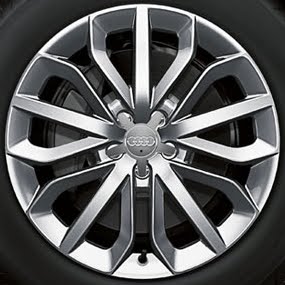
You will notice that, for the sequence of Audi A6 tires, as you go from 16" to 20" the wheels become more open. For the 19" wheels (see picture below) you can look right in, reminding CelloMom of a cathedral window: open, beautiful, and very delicate.


Audi A6, 19" wheel. Rose window in San Vigilio, Trento, Italy

Call CelloMom a nerd. (She won't deny it.) When it comes to cars, she is overwhelmingly more sensitive to actual function than to looks or ideas. She never lives in the conditions where the improved performance of plus-sized wheels would make a difference. She's more than happy to drive in a vehicle with the regular set of tires: More rubber between the rims and the road means more protection from things like rattling teeth, dented rims, ice-skating cars, and the depletion of the purse. We'll take it.

December 14, 2011

Preview: Volvo V60 Plug-in Hybrid

CelloMom can forget about a test drive in this one: There are just a handful of them for sale in 2012. Volvo plans to make 1000 of them for 2013, and 5000 in 2014 (!) of which 30% will remain in Sweden, and the rest doled out to other European countries. But the specs on this baby are enough to make you want to buy a ticket to Stockholm. Certainly enough to make your green-leaning heart beat wildly with desire.

Developed by Volvo and the Swedish energy provider Vattenfal, this is a hybrid with a twist: The five-cylinder 2.4L turbodiesel engine drives the front wheels at 215HP. The 70HP electric engine lives in the back: to be precise, between the rear wheels which it drives. Logical, no? The drawback is that the battery takes up the space where formerly the spare tire used to live. Check out the autoblog.nl gallery for nice cut-out images of the engine placement, as well as other photos, e.g. for the truly distracted among us, the dashboard backlight goes from blue to green to red as your fuel is depleted (no knowledge of Dutch required: these are pictures).

There are three buttons on the dashboard for choosing your driving mode: In the "Power" mode the turbodiesel engine gives that kick (from 0-100kph in 6.9 seconds, if you're into that kind of thing). One would have to be careful when carrying the cello, or eggs. In the "Pure" mode the electric engine does all the work (all 70HP of it); its range is up to 50km (30miles); charging it on a 230V outlet takes 7.5 hours at 6 Amps, or 3 hours at 16 Amps.

The "Hybrid" mode is the intermediate mode that gives the high fuel efficiency. CelloMom hopes you will not be taken in by the 124mpg number, since European fuel efficiency tests are wildly optimistic especially for the most frugal cars. For instance (see table below), the most frugal non-hybrid version of the V60 (which is also unavailable in the US) is the DRIVe with its 1.6L turbodiesel engine and a fuel economy quoted as 52mpg. In real life, as reported by real drivers, this model gets 39mpg, really not bad for a car of this size and weight.

Remembering that official European fuel economy numbers can be off by up to 40%, CelloMom's guess for the Volvo V60 plug-in hybrid is that its real fuel use will be in the 65-80mpg range.

Is 80mpg for the hybrid versus 39mpg for the turbodiesel enough to justify the price difference? Well- no. At European gas price levels, which have been around $10/gal (give or take a few bucks) you would be saving about $18,000 if your drive the car for 150,000 miles. That only accounts for half the price difference. At least another €4,000 (US$ 5,200) is because the "Kinetic" trim quoted in the table is the least expensive option, whereas the "Pure Limited" trim is bound to have all the bells and whistles, and then some. After all, this is a "Limited" edition, aimed at business use. The rest of the price difference can probably be chalked up to the novelty coefficient.

CelloMom, who is not an early adapter, prefers to wait until the kinks have been ironed out, and the price has come down once the widget has been made available to the masses. You can passively hope that this car will eventually make its way to American shores, or you can start talking to your Volvo dealer now to let them know that you want this baby!


Volvo V60 Estate, Turbo-Diesel vs. Plug-in Hybrid

TurboDiesel Plug-in Hybrid
Type DRIVe "Kinetic" "Pure Limited"
Year 2012 2012-2013
Emissions rating EURO5 "A"  
MSRP € 36,695 ($49,150) € 64,695 ($84,100)
CelloMom Rating *
Fuel Economy:
City/Hwy quoted 5.2 / 4.1 L/100km  
Avg. quoted 4.5L/100km (52mpg) 1.9L/100km (124mpg)
Avg. actual 39 mpg (Honest John) EST. 65-80 mpg
Engine

1.6L 4-cyl. turbo

2.4L 5-cyl. turbo
Power 115HP @ 3600rpm 215 HP (diesel)
70 HP (electric)
Gears 6-spd man 6-spd auto
Fuel Diesel Diesel
Length, mm(in) 4628mm (182.2in)  
Width, mm(in) 1865mm (73.4in)  
Height, mm(in) 1484mm (58.4)  
Weight, kg(lbs) 1537 kg (3389 lbs)  
Trunk volume, liters(cuft) 430 L (15.2 cuft)  
Turning radius, m(ft) 11.5m (37.7ft)  
Top speed, kph(mph) 190 kph (118mph)  

December 9, 2011

Can you do without the - now optional - spare tire?

Personally, CelloMom could do without the spare tire. But what about one for a new car? Very, very quietly, carmakers have stopped including a spare tire in their new vehicles. After all, taking things away can't be done with the same fanfare as when adding new features. Can you just see the ad? Cue deep male voice: "The NEW and IMPROVED Jeep Wrangler, now WITHOUT spare tire: because we want YOU to enjoy the extra 0.05 mpg!"

Most modern cars do get increased fuel efficiency when their rears are as smooth as possible - which is why they had the spare in the trunk.

Taking the spare out of the trunk decreases the total weight of the car by about 25lbs, or less than 1 percent of the total curb weight, from around 2500lbs for a small car like the Fiat 500, to over 4000lbs for a minivan. Don't buy the carmakers' tearful argument that they were driven to remove the spare tire by the harsh requirements of the new fuel efficiency standards: that argument doesn't wash.

What are your options? You can settle for the inflator kit that is offered for free. You can buy the optional "donut", a nearly-roadworthy torus that allows your car to limp to the nearest garage. You can buy a full-size spare tire, for up to $300. You can, on some models, opt for a set of "run-flat" tires, which can get you to the next garage even when completely flat, without damage to the rims. Those cost quite a bit more than $300.

There's the real argument: it's a cost-cutting measure. They make you pay $300 for something that they used to throw in standard and for free. And then they have the chutzpah to crow that there is suddenly SO much extra space in the trunk.

CelloMom will always opt for the full-sized spare. The roads and streets around where CelloMom lives are just not cleaned often enough or well enough. CelloMom is blessed with a flat tire about once a year, usually on some quiet road where it's nice that you can get yourself back on the road. CelloPlayer is getting pretty good at those tire bolts. If it ever happens on a highway it would be better to call AAA for help: it's just too dangerous to be messing around when just a few feet away traffic goes by at 65mph.

CelloMom found out about this spare tire issue when helping her dad buy a new car, over the summer in Holland, where he lives. He was offered, and refused, the option of the full-size spare. CelloMom was amazed. Here was a guy who is seriously into backup (that, anyway, is his excuse for owning three rather complete sets of tools). On one trip he brought a spare cylinder head; he put up with the teasing, until the spare ended up saving the trip. On certain road trips, like those in Indonesia, he is not happy until he gets at least two cars to go. With a spare tire in each car. And here he is saying no to a spare tire for his new car?

"You're just too stingy to cough up the 200 Euro", CelloMom said. We like to tell each other the truth. He turned around, and said,

"I haven't had a flat in forty years."

Whoa. CelloMom's dad loves his car. He regards it as an extension of himself. He digs the whole motel deal, where you can sleep right next to your car, but camping is better, because you can sleep in your car. He goes nowhere without that car, even though he lives in a country with excellent public transport and even better bike paths. He logs the miles. Okay, so Holland is a small place: but that's not where he rakes up the miles. Until CelloMom's mom passed away, they used to be on the road, all over Europe, for a minimum of five weeks a year. In a camper, mostly. By far their biggest vacation expense was gasoline.

Forty years of car travel like that, and not one flat? Either he's improbably lucky, or the roads are just cleaner over there. Or both.

December 8, 2011

Keeping up the pressure

Since CelloMom has pledged to warm herself up in the mornings by moving rather than turning up the thermostat, the yard has started to look mighty tidy. The carport is next, but first it's the turn of the car itself, on which the tires are looking a bit soft.

See this widget?

It's a bike pump adapter; you can get it at your local bicycle store. CelloMom got hers at a Dutch market (veggies, flowers, bike parts; all you need really). It cost one Euro, which today is about $1.50, and tomorrow might be anything, depending on whether or not the Europeans manage to keep themselves together monetarily.

But we digress. The pump adapter, which usually lives in CelloMom's spare change purse, goes on the tire valve and makes it look like a bicycle tire valve. Out comes the bike pump, and in goes the air. When CelloMom was done it was suddenly no longer a crisp morning, but rather a mild day - very mild for December. Those tires really were soft; shouldn't have let it go this far.

For $1.50 (and a bike pump, which was already in the shed), you can save the $1 you need to feed the air pump at the gas station, plus $10, the daily cost of a gym membership, and a chunk of the heating bill for today. Now that's a win.

December 2, 2011

Bring back the light!

Check out this German jousting armour. This is Protection with a capital P! The plates are good and heavy. The helmet has slits for eye openings, to keep the knight's eyes from being gouged by the opponent's lance, as he is aiming to dislodge the crest from the helmet. If the opponent is wearing similar armour, his vision wasn't all that good, so aiming that lance is a tricky business.

Fast forward to the present: When buying cars, we check out the safety ratings, because in the case of an accident we need the frames of our cars to give protection to ourselves and to our children.

But times have changed. CelloMom can't remember the last time she saw a jousting knight thundering out of the woods and onto the two-lane roads in her town. Can you? -- So why are the windows by the back seat getting smaller by the year?

As an example, consider the Honda CR-V, one of those CUVs much favoured by women. One assumes that a decent fraction of those women are moms who use their CR-V for ferrying their children. In a 1998 CR-V children had a glorious view out of their window. As long as you were in a child seat, you could still see down to road level.

Those children would not be happy if their mom bought a 2011 CR-V to replace her old trusty one from 1998. Just as the kids have grown from tots to teens, the window area in the back row has shrunk - by quite a lot. The bottom of the window frame has been raised, and the top of the frame is lower. Not only that, the third window has shrunk to the size of an afterthought. Now that the children have grown to who knows what heights, they would have no trouble looking down to the road surface, but they couldn't see the sky without some creative contortions on their necks, or else they have to do what you keep telling them not to do, which is to slouch way down on their seats.

Why would a car designer do this? Surely not to please the children in the back seat, but rather their parents, who after all are the ones who have to sign the financing papers. It has been suggested that when the bottom of the window frame follows a rising line towards the rear of the car, it makes the car look more sporty. Hmm. CelloMom could do without that one. CelloMom is all for her self being sportier than her car.

So the top of the window frame follows a downward sloping line, from the front to the rear of the car. If the roof were made to slope that way also, there is a very good aerodynamic reason for it, since the downward curve actually contributes to the fuel efficiency. Some models just end up looking like a large gorilla has been sitting on the rear end of the roof. On cars like the Toyota Prius or the Honda Insight, not only does the curved-down roof look pretty, the outline of the car resembles a leaf which pleases the green-leaning buyers.

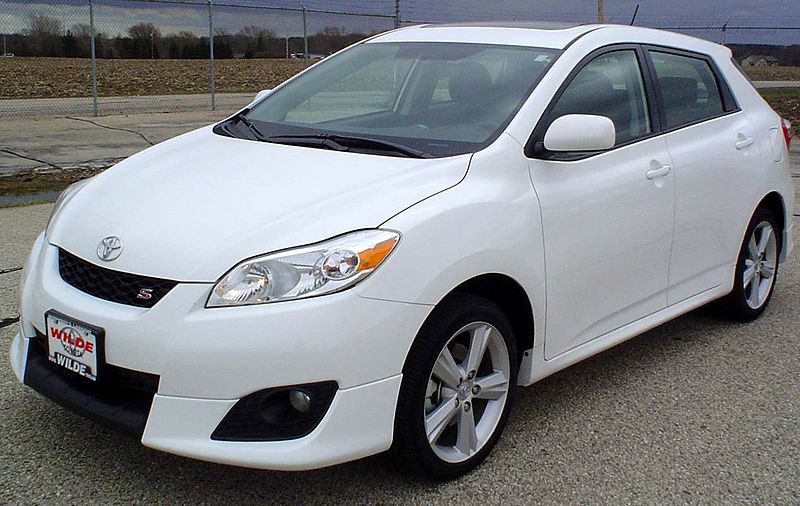
But what to think of a car of which the windows follow the downward curve, while the roof stays reasonably flat? The Toyota Matrix is one of many examples. The overall assembly looks pretty enough. But then you get a nagging feeling that it's only appearing to be aerodynamically correct without actually being so. Reminds you of those politically correct university science departments whose websites trumpet their women-friendliness but whose sole female faculty member can be found in a lab in the basement.

At last, in 2012 the Matrix has a roof that actually curves down, so that the line of the roof follows the line of the windows. But the children on that back seat had better not grow to basketball players. Besides, they've taken away the third window altogether, so sitting in the back now feels like occupying a cave. Because the bottom line of the window frame is still tilted up.

But - the whole point of a car ride is to look at the world outside. Even on the daily ride to school, somehow there is something interesting to see every day.

Children in the back of a 2012 Matrix can still try to peer through the front side windows, which have remained relatively high. The same cannot be said of the side windows of the new Range Rover Evoque, which are small front and back. It is not entirely clear what this car is supposed to evoke; to CelloMom it only brings to mind the image of two gorillas dallying on the Rover's roof all night, leaving at daylight completely satisfied - in the knowledge that they have ruined a perfectly good car. The Evoque resembles nothing so much as that medieval helmet with the slits. What are its owners so afraid of?

November 30, 2011

Review: Nissan Murano

Crossing over into new territory, CelloMom considers the Nissan Murano, a crossover utility vehicle, or CUV. Had to look up what the term means, exactly: a CUV is built on a passenger car platform but borrows elements from SUVs, hatchbacks and station wagons.

The Murano comes in rather a sweet and well-proportioned package, as viewed from the side, and as long as one is careful not to look at it head on; following the current trend the front of the car presents a grim face which is called "agressive" with a measure of admiration which is baffling to CelloMom.

True to its name, there is plenty of glass on this car: the windows of the back row remain reasonably large, which is nice for the denizens of the back row who tend to be short people. And you can optionally get a moonroof which unfortunately comes in two parts, one sliver over the front seats and another sliver over the back seats. Even if the bar in between is necessary for structural strength, it does mean that the moonroof is less than breathtaking.

Of course, you don't need the moonroof for backseat navigating, since the Murano comes with a navigator built into the dashboard. The other cool thing on the dashboard is the ON button, which is all you need to get the car started, just like in the old-fashioned Jaguars. No need to ever get your car keys out of your pocket, even for getting into the car. Nice for those times that you have a toddler and groceries in your arms and it's raining and you really don't want to be fishing around for your keys.

There is more than enough space in the back for a cello, and the total cargo space can be enlarged to a nice 64cuft with the back row folded down to make a flat floor, at the height of the opening of the hatch. There is plenty of legspace for tall people even when seated in the back.

But this is one heavy-boned car, weighing in at 1742kg (3841 lbs), a lot more than the weight of a nearly-full-size car like the Honda Accord, "only" 1487kg (3279 lbs). It's not just from its over-sized 3.5L V6 engine: even the Japanese version with the 2.5L 4-cylinder engine still weighs 1650kg (3637 lbs). You wonder where all that weight goes.

Nissan does not offer the Murano for sale in the UK. In the Netherlands, you can only buy the 3.5L version, and MRSP starts from € 69,350 (US $ 93,200): it falls in the "F" category for CO2 emissions, so it got hit by the gas-guzzler tax. Cars in general, and certainly SUVs, are really cheap in the US.

Bottom line for CelloMom: Nice car, cool tech, lots of room. But we're past 20mpg now. Even the smaller 2.5L engine only gets around 25mpg (and that's being generous: the Japanese 10.15 standard tends to gross overstatement of fuel efficiency) . Not for this century.


Nissan Murano, Same-Model comparison, different engine.

US Japan
Type S FWD 250XL 2WD
Year 2012 2012
Emissions rating ULEV  
MSRP $ 29,290 ¥ 2,971,500
$38,250
CelloMom Rating
Fuel Economy:
City/Hwy quoted 18 / 24  
Avg. quoted 20 mpg 11.6km/L (27mpg)
(10.15 schedule).
Avg. actual   between 22-25mpg
Engine

3.5L DOCH
V6 24-vlv

2.5L 4-cyl.
Power 260 HP @ 6000rpm 170PS @ 5600rpm
Gears Xtronic CVT (auto) Xtronic CVT (auto)
Fuel Unleaded Regular Gasoline
Length, mm(in) 189.9in 4845mm
Width, mm(in) 74.1in 1885mm
Height, mm(in) 67.0in 1700mm
Weight, kg(lbs) 3841 lbs(1742kg) 1650 kg (3637 lbs)
Trunk volume, liters(cuft) 31.6 / 64 cuft  
Turning radius, m(ft)   11.4m
Top speed, kph(mph)    

November 25, 2011

VW Bulli is a turkey

You know CelloMom loves Volkswagens. But it was with dismay that she first greeted the new VW concept microbus, nicknamed the Bulli. Allright, it was actually a viscreal reaction: "Eeuw!". The Bulli gets CelloMom's 2011 Turkey Award.

The new 2012 Beetle was actually a runner-up, but someone has already stomped on that one so it now looks like a squashed bug, saving CelloMom the trouble. But the more she heard about this Bulli thing, the more it started to look like a Christmas tree festooned with glittering gimmicks.

First gimmick: it was designed, and even painted, to remind of the very successful VW Type 2, variously known as the VW bus, the camper, the hippiemobile, etc. Tug the heartstrings, cue the violins - I mean the Grateful Dead.

You might argue that the T1 was ugly; but it was ugly with character. It invariably invokes an "AawwWW!" from CelloMom's chidren whenever we spot one on the road. Besides, you learned to love its homeliness for all the good times you had travelling in it. Even when it did break down you could repair it in the comfort of its shelter. CelloMom is not tall and appreciated the T2 because she could swing the kitchen out of the way, remove the engine cover, sit over the engine and really reach in, even using leg strength for tightening the fan belt. Try that with a front-engine model.

If the Type 2 was called a microbus, the Bulli should be classified a nanobus. It is not long, about the length of a Honda Fit. It is said to carry six, because its body is quite wide. But still, behind that protruding engine in the stubby nose, and two rows of seats, there is barely room in the very back for one cello. Perhaps a guitar and a small amp. Forget about camping gear.

So it's wide, short and boxy on the back. Only a piece of plywood with the same frontal area has more air resistance. Even a turkey (with its tail down) has better aerodynamic design.

The model rolled out at the various auto shows this year was fitted with an electric engine: another gimmick playing to the current infatuation with EVs.

And that iPad installed on the dashboard! CelloMom has nothing against iPads - except when they live on car consoles. Can you just see the roadside scene, police cruiser's lights flashing: "OK, driver's license. Right. Say, officer, can you hang on one minute? I'm on this online game and I just need 5 more points to get to the next level."

Let's hope the Bulli will never see the production line. What's wrong with the VW Sharan? Except for its utter unavailability in the US.

November 23, 2011

Review Update: Volkswagen Passat

It's starting. After years of steadily nudging up engine volumes, inevitably with decreasing fuel efficiency, Volkswagen has bucked the trend with the introduction of the 2012 Volkswagen Passat 2.0L TDI. 31 / 43 mpg (cty/hwy), 140HP, more than enough power to navigate the nation's highways.

Despite grumbling about the CAFE2025 standards, because those are more than indulgent in the small trucks & SUV sector, apparently Volkswagen has moved to comply anyway, by starting to offer more fuel-efficient models in the US. It's the easy way. It's about time. And they didn't even go all the way.

The Passat Bluemotion 2.0L TDI still gets higher mileage, 48mpg in real-life use. This is the one that in Germany is called the "BlueTDI". It comes with a few extra fuel-saving technologies, such as a Start-Stop function that turns off the engine instead of allowing you to idle.

Moving another step ahead, but in European markets only, VW has introduced the "New Bluemotion Passat". This one comes with a 1.6L TDI engine. Its 105HP is plenty of power for the flat terrain of northern Germany (as well as for large swaths of the US, such as the midwestern plains). While its claimed mileage of 4.1L/100km (57mpg) is overstated, it will do better than the 2.0L version's 48mpg.

Best of all, the price on the New Bluemotion 1.6L TDI is €3,000 lower than that of the 2.0L BlueTDI, for equal trim. What's not to love? It will come to the US - eventually: a few years from now, when the CAFE2025 fuel efficiency requirements really start to squeeze.

November 22, 2011

Where are the women writing about cars?

Vive la différence! Of course women are different from men. It is said often enough that they are tribes from two different planets. So of course their choice of cars, and their motivations for that choice, are not the same. Then why is it so difficult to find women among the legions of car reviewers?

This post was written for BlogHer; read the rest here.

November 18, 2011

Men buy throbbing engines, women buy gas sippers with style and safety

The movie "Cars" is packed with vehicular stereotypes, from the rusty but trusty country truck, to the VW minivan peddling gas ("I got organic fuel, man!") to the heroine and enabler (the character whose actions make it possible for the hero to achieve his resolution).

The heroine, a light blue Porsche 911, is an icon. Everybody recognises it, its curves are irresistible, and male cars are supposed to go gaga over it.

In real life also, it is overwhelmingly men who fall in love with and buy the Porsche 911. A study released this spring by Truecar, the car sales specialists, is as crowded with stereotypes as "Cars" the movie.


Truecar collected data on more than eight million vehicle purchases in the US in 2010, and for each make and model tallied the percentage registered to men and to women. Among manufacturers, women favour Minis; Ferrari's sales go to men by a huge margin. The top ten brands favoured by women give, on average, a higher discount from the MSRP than the top ten favoured by men. CelloMom supposes that when you're buying a Maserati or a Jaguar it looks less than dignified to be niggling on the price.

The Truecar study lists the ten car models most favoured by men, that is, with the highest percentage of males registering the car. In the table below, CelloMom has added the columns characterising the cars.


Top male purchases in 2010

Make / Model %
Male
Engine
Volume
MPG
cty/hwy
HP MSRP
"from"
           
Porsche 911 87.9 3.4L 18/25 350 82,100
Chevrolet Corvette 86.7 6.2L 16/26 430 49,525
BMW M3 85.6 4.0L 14/20 414 55,900
Audi S5 83.0 4.2L 14/22 354 53,900
Average peacock feather   4.5L 16/23 387 60,356
           
GMC Sierra 87.4 4.3L 15/20 195 21,945
Chevrolet Silverado 86.3 4.3L 14/18 195 21,945
Ford F-150 86.3 3.7L 17/23 302 22,990
Ford Ranger 84.4 2.3L 22/27 143 18,160
Toyota Tundra 84.3 3.0L 16/20 270 27,115
Dodge Ram 84.2 3.7L 14/20 210 21,475
Average practical truck   3.6L 16/21 219 22,272


CelloMom has taken the liberty of scrambling the order, to group the cars in two categories: practical and otherwise. The first four cars fall in the latter category: they are all display devices, and we're not talking computer screens. Men are just programmed to display their prowess like peacocks, stags and stallions. In the old days, they would go for the chariot with four barely-in-control stallions. Now, in the industrialised west, they go for four-wheeled vehicles propelled by engines with the power of 400 horses. Never mind that on the streets of Manhattan or on the congested LA freeways you never get to use all that horsepower, just like in the crowded streets of ancient Rome a team of fiery Arabian stallions was more a liability than a pleasure ride.

The point is, these cars exude an aura of power and prestige, and the bank account that goes with that. Either that, or a desire to project an aura of power and prestige, even if it comes with an oversized car loan that you have to pull like the peacock dragging its tail wherever it goes. You can't deny it's a show-stopping animal, though. The peacock that is. Oh allright, CelloMom herself does have a soft spot for the 911. Pity it just won't do for the family. Not to mention the cello. The budget? - you don't think about budget when you think of the 911.

*Sigh*. Moving right along. The second group of cars in the table above are not cars, but trucks. (Isn't it interesting how it's okay to call an Odyssey a "mini-van", but it's out of bounds to call a Tundra a "mini-truck"? After all, these are not your Mack 18-wheelers). Many of their drivers buy these trucks from a strictly utilitarian point of view; think of construction workers who have to haul large and heavy things regularly.

One example is CelloMom's friend Jonathan, an imaginative stone sculptor who prefers to work with upcycled material. Once he hauled five huge chunks of granite salvaged from an old stone bridge that was being replaced by a steel one; together these must have weighed close to 7500lbs. For that kind of load you need something like a Chevy 3500; Jonathan's has a double set of wheels at the back, and an immense turbo-charged engine that runs on diesel. When he starts it up the whole neighbourhood knows it.

Another truck-driving example is CelloMom's friend Chris, who owns a 17-horse barn that she runs largely by herself. She drives a Ford F150 for hauling hay bales, fences and such, and to hitch the horse trailer to when she takes students to a show. But CelloMom knows she's been eyeing a used VW Beetle to use as a city car, for the manoeuverability and the better fuel efficiency.

Funny that, about the Beetle. It happens to be the car with the highest percentage of women buyers, 60.6%. In the table below CelloMom has again re-arranged the order of the list, to sort the cars into two groups.

You might not think that the 52-55% in the list is an overwhelmingly large female percentage, but you need to keep in mind that in the Truecar study, women account for 34% of the car registrations overall. Yet a University of Pennsylvania study has found that in the US, about equal numbers of men and women hold a driver's licence. Probably part of the difference is because in many families a car might be registered to the husband even though it's used primarily by the wife. So take the percentages in the table below with a grain of salt.


Top female purchases in 2010

Make / Model %
Female
Engine
Volume
MPG
cty/hwy
HP MSRP
"from"
           
VW New Beetle 60.6 2.5L 22/31 170 19,795
VW Eos 55.3 2.0L 22/29 200 33,995
Volvo S40 54.5 2.4L 21/30 168 26,200
Nissan Sentra 53.5 2.0L 27/34 140 16,060
Toyota Yaris 52.7 1.5L 30/38 106 14,115
Average stylish sipper   2.1L 24/32 157 22,033
           
Nissan Rogue 56.3 2.5L 23/28 170 21,530
Jeep Compass 54.3 2.0L 23/29 158 19,295
Honda CR-V 53.8 2.4L 21/28 180 21,895
Hyundai Tucson 53.2 2.0L 23/31 165 19,045
Toyota RAV4 52.7 2.5L 22/28 179 22,475
Average shining armor   2.3L 22/29 170 20,848
           

The cars in the upper half of the Women's table have a mix of style, fuel efficiency, and safety in varying proportions. This is a set of good-looking cars, and it's probably safe to say that the Beetle is a design icon. All the cars have decent mileage - and CelloMom's guess is that, if the smaller-engined versions were available in the US, many American women would buy them, since women's car purchases are influenced by the issue of fuel efficiency.

However, CelloMom has heard many moms say that they would love to buy a gas sipper but that those make them feel less safe on the road, which they have to share with heavier vehicles like those in the Men's list, above.

The safety issue is part of the reason why SUVs and cross-overs, like those in the bottom half of the Women's table, feature so prominently in women's choice. SUVs tend to be heavier than sedans and hatchbacks, and you sit higher, which gives you a leg up on those ridiculously high SUV bumpers, and a better view of who might be inclined to bump their manly truck (or larger SUV) into the vehicle in which you're ferrying your children. Although chivalry is far from dead, there sure is a dearth of it on the road. So, if the knights around you are just interested in their own chargers, perhaps the best you can do is to surround yourself in your own shining armour.

From the Women's list it's clear that horsepower is not a women's preoccupation: apart from the VW Eos, all the cars in the Women's table have less power than those in the Men's table. In order to make a fair comparison, for each model CelloMom has chosen the engine with the smallest power, the one that tends to have the lowest price tag as well.

On the whole, things are not as black and white as suggested by the catchy titles of the articles covering this study. The study itself it titled "Men go for looks; women opt for practicality"; but CelloMom would say both men and women go for looks or practicality, each in their own way. The folks at CarFinder advanced the title "Men like trucks and chicks dig VW". Okay: sure grabs your attention.

So here is CelloMom's gambit for a catchy title that ignores the nuances revealed by the Truecar study, with a nod to the town that houses Volkswagen's headquarters: "Men are from Mars, women are from Wolfsburg, Germany".

November 14, 2011

Hand my car keys to a 16-year old? No, thanks.

It appears CelloMom's eldest bucks the trend of teens who are not burning to get that driver's licence the moment they turn 16. The local high school offers driver's ed for sophomores, and Eldest at some level really believes that, at sixteen, CelloMom will release the family car to carry a bunch of teens to Arizona. For cactus watching. (We all need our dreams, right? And hey - among things that could attract teenagers, cacti would rank very high in CelloMom's list of preferences).

CelloDad keeps pointing out that he was a young 32 when he first got his driver's license, and there is no reason why his children should be any younger. But CelloDad is being disingenious: he lived in the Netherlands, and got around on his bike and trains and buses, occasionally getting rides with friends who did brave, and pass, the murderous driver's test.

Teens and cars are a dangerous combination. The mortality rates in traffic accidents is a few times higher for teens than for the population average. Once, a long time ago, CelloMom herself nearly died in a car driven by a teenager. On a road trip.

So no, we're not ready to relinquish the keys to the car, thank you very much. Not until they pass the in-house road test, administered by CelloMom, which will be much more strict than the Dutch one. CelloMom looks with amazement at sites where people discuss wrenching questions like "What is a good teen car?" Euhh: a bike? For getting around town, that will have to do; for young legs it should be no problem. Later on in college? We'll have enough on our plate dealing with the tuition. Later later for the first job? That's our children's problem, not ours. Hopefully they will be sensible enough to save up for a used car rather than get an expensive car loan for a shiny new one.

Meanwhile, we are happy to supply the rides, to wherever. The library when it's pouring. The mall. Even the local nursery, to supplement the growing collection of cacti.