-->

May 31, 2014

Size Creep

When I was pregnant, I started wearing men's T-shirts over skirts of which the waist had ferocious stretch. After all, my waist was going through a ferocious stretch. It was very comfortable to wear clothes that matched that.

By the time I was ready to buy new clothes again, it was a decade later, and I had all but forgotten what my size was. A store assistant sized me up and said, "You'd be a six, ma'am. Maybe a four."

From the way she turned away from me I could tell that my face was set to maximum incredulity. It was all I could do to keep myself from saying, "You're out of your mind. Before the babies I was a ten. I'm sure I'm a twelve now. There is no. bloomin'. way. that I'm a six."

I tried on a few things.

I'm a six.


[Original painting: The Abduction of Deianeira by the Centaur Nessus (ca. 1640) by Peter Paul Rubens, the painter of all those "rubenesque" ladies.]

I went home and rifled through my old stuff. Sure enough: a decade has passed, and now six is the new twelve. This size creep is downright creepy, if you ask me. I don't like to have my perceptions manipulated, thanks very much.

May 29, 2014

Enough Hockey Sticks for TWO Teams

Now that my eldest has gained admission to a Canadian university, I am reminded that hockey is the Canadian national sport. And that my best friend in college used to play it: she learned to skate in an unbelievably short time, and got so good at running circles around everyone on the ice that she was appointed the captain of my dorm's co-ed hockey team, competing intramurally.

Before games, she would go around the dorm, tear people away from their problem sets and papers, to scrape together enough players to field a team of six (including the goalie). If she was lucky she got a few extras. I would come to some of the games, to shout.


These days, I don't think of hockey much. But I do think of hockey sticks, a lot. Michael Mann, the climate scientist, has done pioneering work on how the globally averaged temperature has been steady for nearly 10,000 years - if anything, decreasing slowly - until the onset of the Industrial Revolution. After that global temperatures started rising rapidly. So if you graph global average temperature as a function of time, the data lies on a curve that resembles a hockey stick.


Lots of global warming deniers have tried to beat up on Michael Mann (with non-physical sticks, like law suits) but the hockey stick metaphor has proven robust and, if anything, has become stronger over time. And while globally averaged temperature is the first quantity shown to have time dependence resembling a hockey stick, it is not the only one.

There are in fact enough hockey sticks to field a whole team, plus a few backups.

May 16, 2014

Warning Labels for Gasoline Pumps

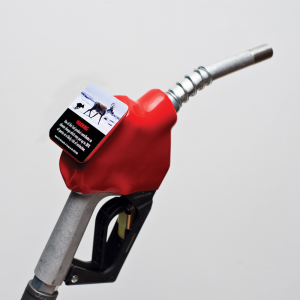
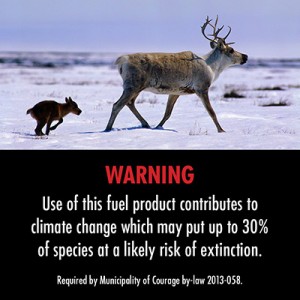
A plucky teen has let her voice be heard, even though she is not yet old enough to vote. Emily Kelsall, a sixteen year old living in West-Vancouver, sees clearly the link between global warming and the everyday action of filling a car's gas tank, and wants drivers to see it too. In order to help motorists connect the dots, she has taken a proposal to West Vancouver's municipal council.

The way to get her message out is very simple: put warning labels on the nozzles of gas pumps. Every time drivers fill their tank, they can't help seeing the label reminding them that every mile they drive contributes to the carbon emisssions that are causing climate change, with consequences that we can all feel even today.

Emily Kelsall was inspired to her extraordinary action by hearing a radio interview with Rob Shirkey, the founder of Our Horizon, who points out that municipalities (at least the ones in Ontario) "have the legal authority to require gasoline retailers to put warning labels on gas pumps similar to those found on cigarette packages". And that cities and towns should use that authority.

May 14, 2014

I Bleeping Love Science

Well, that's it. I've come to the end of a broad overview of planetary science as it pertains to climate change. Affectionately known as 12.340x, it's a course (online through edX) on Global Warming Science, given (mostly) by MIT's Kerry Emmanuel.

In contrast to the World Bank's course on climate change that I had taken earlier (through Coursera), this one was all about the science, and explicitly not about policy. In twelve weeks, it surveyed topics like paleoclimate, the composition of the atmosphere over earth's history, heat transfer of all kinds, atmospheric and ocean circulations, the carbon cycle, forcings and feedbacks, and finally a little bit about the models that need to incorporate all of that in order to give us a sense of where we're headed next.

When you start to get into the details of how it works, you get your nose rubbed into it: our planet is stunningly beautiful.

As a single example, take the thermohaline circulation: it's the large-scale ocean flows, driven place-to-place differences of temperature and salt content, that churns the oceans and help transport heat from tropical regions towards the poles.

The "conveyor belt" looks a bit like the blood circulation in the human body. In the Atlantic, waters flow at the surface toward the North Pole (mostly scrunched into a narrow strip: the Gulf Stream), then sinks down, flowing back toward the South Pole at large depth.

May 11, 2014

Road Safety

In 2013 there were 570 road deaths in the Netherlands. Of those, more than half - 320 - were non-vehicle deaths, that is, pedestrians, bicyclists, and riders of scootmobiles: electric mobility aids that share bike paths.

Small numbers. But then again, it's a small country with population less than 17 million. For a more realistic comparison, we divide the road death numbers by the population, and find 34 road fatalities per million, about half the European average.

For comparison, in 2010 there were 32,885 road deaths in the US, or 107 per million, the overwhelming majority were drivers or passengers of vehicles. That seems a lot more until you remember that Dutch people don't drive all that much or that far. Very, very few have the supercommutes that are not uncommon in the US. I mean, in most places in the Netherlands, driving three hours would land you outside the country and in some places, two countries over.

May 7, 2014

National Climate Assessment: Why I'm Cautiously Elated

The National Climate Assessment, the culmination of a four-year effort to catalog the effects of climate change on the United States, is a breath of fresh air in the national discussion of climate change.

Finally, scientists are saying it like it is, without using technical jargon or probabilities: The NCA report states bluntly that climate change has arrived in the United States, and spells out the many ways that it is making life harder - and more expensive - for many of us. That's us, not our children or grandchildren.

The report emphasises that, as we have already started to see, climate change is not about a gradual warming up of the place we call home: it's more properly called climate disruption, or even climate chaos, where wild weather events frequently dominate the news.

The report is huge. But it is not a dry document stuffed with scientific jargon, equations and graphs. It has been presented on a beautifully crafted website that is easy to navigate at several levels, from a cursory look at the key points, to the "highlights" to an in-depth look at the relevant pages of the report itself. The designer(s) of this fantastic site deserve a medal, really.

May 2, 2014

Our Children's Trust

Our children look to us to feed them when they are hungry. They come for a hug when they are scared, or very happy, or just for the joy of being hugged. When they have a boo-boo we kiss their tears away. And they count on us to do all that: to keep them safe, healthy and happy. We have our children's trust on a personal level; it is an enormous responsibility that we take on when we become parents, and one that we bear gladly.

It is in fact such a large responsibility that many of us make provisions in case we die while our children are still minors: we write wills that specify who will take care of our children, and who will manage whatever funds and property we may leave for them, until they come of age. That person is called a trustee, for the trust we invest in them, to act like a parent in our stead.

Looking up the legal meaning of the word Trust, I found this:

In common law legal systems, a trust is a relationship whereby property is held by one party for the benefit of another.

In the context of our home, the planet, that sounds a lot like the native American saying:

April 22, 2014

Google Maps: directions with options

First there was "You can't get there from here", that phrase that country folk love to trot out when a hapless out-of-stater got hopelessly lost in Maine and had to resort asking the natives for the directions. Or so the out-of-staters said.

Then there was the AAA Trip-tik: the set of mini-maps where the friendly AAA representative highlighted the route you were to take to get from A to B. Depending on the trip, you could end up lugging a small library back to your car, of the Trip-tik itself, plus the maps and the AAA guides that went with it. For a cross-country trip we're talking the weight of a small encyclopedia.


Photo by Darren Meacher

Then - oh marvel! - there was the GPS device that was built in or (more commonly) precariously attached to your windshield with a suction cup. Super-expensive versions told you the real-time route, accounting for any detours due to road contructions of traffic jams.

But all that is so twentieth century.

April 21, 2014

The travel bureaus that put Jack Kerouac on the road

I may be the most reluctant automotive writer you've ever met, but I'm still an automotive writer, so it's sort of embarrassing that I've never read the quintessential book on autos and motion, "On The Road", Jack Kerouac's paean to high-speed road travel, women and jazz, that marked and inspired the bohemian hedonism of the Beat generation. So I'm reading it now.

I really can get into (or, as the book would say, I "dig") the rejection of materialism, but I can't say I dig the need for speed, the zipping by countless breathlessly beautiful places this country has to offer those who take the time to really explore. All of that natural beauty is just filler material between the cities with their jazz bars and philosophising friends, something to be got through as quickly as possible.

Because all the characters in the book are living from hand to mouth, even a ride on the Greyhound bus is too much of an expense: they hitch rides if they have to, but their preferred way of getting from place to place is by sharing the drive in a private car.


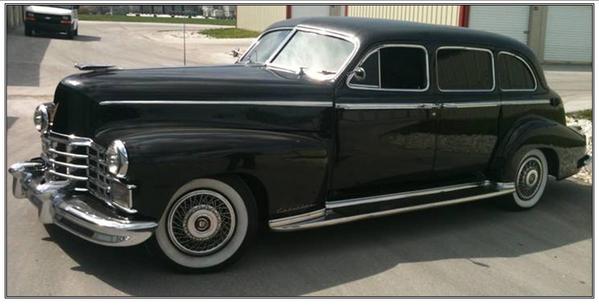
And what cars these are! The most memorable ones are detailed by Dennis Mansker. The photo above is of a 1947 Cadillac limousine, the kind that in the book was whipped from Denver to Chicago (nearly 1200 miles) in seventeen hours, at the end of which it was delivered to its owner's swanky residence, all dented, covered in mud and with the speedometer busted after the first time it was forced past 110mph.

April 12, 2014

Watch "Years of Living Dangerously" - but not alone

There's a buzz going around about "Years of Living Dangerously", the multi-part climate change documentary. It premieres on Sunday, April 13 on the Showtime channel. You can watch the first episode free at the "Years" website and on YouTube.

But before you settle in to watch it, you may want to find someone with whom to watch it, to discuss it, to digest it. Because while the documentary is a masterpiece of storytelling and will be easy enough to watch, it may be more difficult to absorb the message.

April 7, 2014

"There has been no global warming since 1998" - Or has there?

You hear this statement a lot in discussions about climate change. It is one of the most oft-repeated arguments against global warming: The average global surface temperature has leveled off. And it's true.

Just take a look at this graph, which shows the globally averaged surface temperature rise, from 1997 to 2014, compared to the average temperature in the period 1951-1980. The temperature really hasn't changed that much, if at all.

A careless observer would say, that's it: it's settled, there is no global warming, and we can all go home now (in our big fat SUVs, of course). A climate change denier would take this data and crow in comment threads all over the internet (but never in a scientific journal) that 97% of climate scientists are wrong to say that global warming exists, and wrong to say that humans are causing it.

But that is taking a myopic view of the world. And it's not very scientific.

April 6, 2014

Best of #ReplaceBikeWithCar so far

There's a Twitter fest on this weekend, marked by the hashtag #ReplaceBikeWithCar, where people quote things usually said about bikes and riding but replace them with cars and driving.

Check it out: it's good for a quick pick-me-up. A few of my favourites below