-->

July 26, 2013

Car-free in a small town: Wengen, Switzerland

It's relatively easy for large cities like Rome to become very livable by declaring a car-free zone: population densities are so high that it pays, on many levels, to have a dense public transportation network that operates frequently and inexpensively. On the other end of the spectrum, it is also easy for very small villages to go car-free: nothing is far away, and everything in the village is easily accessible on foot.

Very few small villages have the gumption to declare themselves completely car free: The entire planet is dotted with tiny hamlets literally embracing some throughway (the "Main Street") where cars and trucks tear through on their way from elsewhere to somewhere else, leaving only exhaust in their wake. Even Transition Town Totnes at the edge of Dartmoor, one of the most progressively green small towns, has so far only declared a single car-free day, in September 2012.

In contrast, many small towns in mountainous Switzerland have the advantage that they have always been hard to reach by car, and a few have an additional economic motivation to remain car-free altogether, peace and quiet being part of their brand. The valley of Lauterbrunnen is dotted with small villages that are completely car-free year round, like Mürren, the ski resort where Sir Arnold Lunn laid out the first competitive slalom course.

On the other side of the valley, the town of Wengen has a permanent population of 1300. It is perched on a ledge on the valley wall, 400m above Lauterbrunnen in the valley floor, and nearly 1000m below Männlichen on the nearest ridge above. You can get there by cog train, by cable car, by hiking or by skiing.

July 18, 2013

"I Go to the Gas Station Once a Month"


Welcome to the July 2013 Natural Living Blog Carnival: Inspiring Change in Others.

This post was written for inclusion in the monthly Natural Living Blog Carnival hosted by Happy Mothering and The Pistachio Project through the Green Moms Network. This month, our members are talking about how they inspire others to make positive changes in their lifestyles. If you have tips to share, feel free to comment on all of the posts! And maybe you'll walk away with a few tips you can use in your own life.

—–

"You go to the gas station once a month?" My good friend Elise, who normally takes my word for granted, is unable to hide her incredulity. I give her my usual line about how, while I like the guys at the station, I do hand over a wad of cash every time I see them; so once a month is enough, thanks. "Once a month," I hear her mutter, again. We go on to talk about other things, but I do believe I made an impression, even on my friend who is already very green.


It's not easy to spread the word about climate change in such a way that people are willing to listen. This issue is so deeply enmeshed with our security that we simply don't want to hear the bad news. It's like trying to talk to Californians about the risk of earthquakes: they just smile and change the conversation.

Denial is built into our psyche, a safe place to hide behind when we are not ready to face really scary stuff, like our mortality - or the fate of the blue ball we call home. I mean, it's so much easier - and more pleasant - to think about the next smartphone you're going to buy, than to deal with the feeling of depression and helplessness in the face of a problem that's literally the size of a planet.

I'm no psychologist, I couldn't help anyone past their denial stage; so I prefer to go around that. Instead, I like to point out that green living can save a bundle of money. This is certainly true in the long run, and very often gives instant gratification as well. Besides, saving money is something that everybody recognises as a good thing.

My favourite new line is "Green = Frugal".

July 16, 2013

Low Traffic Zones: anything but cars

Europe has a growing number of Low Emissions Zones: This generally means that access to motorised vehicles (especially those with older emissions standards) is restricted in certain areas of large cities. For Rome that's about half of the metropolitan area inside the ring (A90 and E80).

The LEZ area is served by a network of commuter trains and buses. Since a bus or train ticket is valid for 100 minutes after you get on, that can get you from the centre of Rome to anywhere in the greater metropolitan area, even well outside the ring road. Tourists taking the commuter train to Rome's ancient harbour at Ostia can get there for €1.50, the standard metrebus fare in Rome.

But if you happen to choose a sunny weekend day for that trip you will find the commuter train packed with a crowd of beachgoers headed for Lido, discreetly wearing swimsuits under T-shirts and sun dresses, and all happily chattering away. The festive atmosphere inside those cars can get pretty loud, and makes you understand why some longer-distance railway trains have designated quiet cars.

Inside the LEZ area, there are generally zones where most private cars are banned for most of the day, usually in historic city centres.

July 9, 2013

Pedestrians-Only Zone

It could be argued that central Florence is more of a museum than a city. That is one good reason to avert as much car traffic as possible. And that is exactly what the centre-city Florence has accomplished: After a while you realise that most cars you see are the white taxis - and even of those not very many. There are a few bikes plying the cobblestone streets, but mostly people get around on foot. A medieval town is walk-sized, after all.


The way Florence has accomplished this is simply by banning all car traffic between 7.30am and 7.30pm, with very few exceptions. There is apparently a steep fine for cars entering the pedestrian zone without the proper permit. I imagine that handicapped residents are allowed a car (not that there are many parking spaces: those are carefully arranged outside the old town). And there is the fleet of white taxis, many of which are hybrids or EVs: among their number are quite a few Prius+ hybrids, the kind that could in principle seat seven.

The upshot is that the city streets are pleasantly unclogged of automotive traffic: it's so quiet you can hear the flocks of swallows go by as they call to one another. The air is clean, so you can enjoy a good meal at one of the many outside venues. And I bet that the exterior of the magnificent cathedral will stay cleaner for much longer, after the current round of restoration leaves it blindingly beautiful.


Many of the city buses are electric; all are inexpensive and frequent. So it's really silly to try to come here with a car. Besides, walking around you can try to imagine what it was like to be in this city in the heady days of the renaissance, among all the art, literature, philosophy and science swirling around the place.

July 3, 2013

Healthy Eating On Vacation

I love travel: it lifts you out of the everyday, puts a fresh perspective on your life, and opens your mind and heart to new possibilities. But one thing that doesn't go on vacation is my commitment to feeding my family healthy meals. It's one of those positive feedback loops: eating well contributes to happiness, being happy takes a lot of energy - we are never hungrier than when on vacation.


Photo Silver Spoon: Who says eggs have to come in dozens?

But it's not always easy: when I'm at home I know exactly where to go for clean, whole foods: my CSA farm, my milk farmer, the local health food store. When we're travelling all that familiar routine goes out the window and I get to re-invent our food on a daily basis.

One thing I've learned from bitter experience, is not to expect real food at child-oriented venues like zoos or theme parks. I really don't see why children's taste should be so insulted that they are exclusively served fat-soaked and sugar-laden "food". I don't even see why there should be a "Kids' menu" at restaurants: my children eat what I eat, only with smaller portions.

To tell the truth, on one road trip I gave up and stopped at a burger chain, just to be different. CelloDad was surprised. CelloPlayer was bemused but tried this and that. ViolaPlayer categorically refused to eat anything. Even passed up on the bottle of water. Having gone through the Food & Health block at our Waldorf school, and having read Fast Food Nation, my child chose to go hungry rather than submit to the industrial fast food. I have to admire that.

So back we went to our wholesome food regime. This gets easier as you have more money to throw at the issue, but there are plenty of healthy food options that don't cost an arm and a leg.

June 27, 2013

Tar Sands are Incompatible with new Climate Change Plan

President Obama's new plan to combat climate change makes much of energy efficiency, which is a much more popular way to go than advocating a lifestyle change (political suicide) or less gridlock-inducing than a carbon tax (the fastest way to effect lifestyle change). Instead, Mr. Obama chose to highlight the EPA's tightened fuel efficiency requirements for new cars (CAFE), and upcoming efficiency standards for appliances and building construction.

These are all steps in the right direction, but the president was vague on the approval or not of the Keystone XL, the pipeline that is to transport bitumen from Canada's tar sands to the Gulf of Mexico for refining. The controversy around the Keystone XL pipeline tends to centre around the environmental risk, job creation and US energy independence.

It seem foolhardy to rip out boreal forest, dig a 10-mile gash in the surface of the planet, and cart it all off, risking highly toxic spills through fragile environments (the original Keystone pipeline had more than thirty spills in its first year), only to sell the oil on the world market. On top of all that, tar sands have terrible energy efficiency.


Satellite image of oil sands operation at Fort McMurray, Alberta.

The days of gusher oil wells, where all you have to do is drill into the ground at the right place (not very deeply), and oil comes bursting out, are long gone. These days you have to spend energy to get energy: you need to drill deep, or sideways, or you need to pump the oil out, or carefully inject water to keep the pressure up. Hydraulic fracturing of shale takes immense amounts of both energy and water. The sun and the wind come to us for free, but harvesting their energy takes the building of wind turbines and photovoltaic cells, and that takes energy.

So the question we need to ask is, how much energy does it take to get one usable unit of energy from the various sources in our reach?

June 23, 2013

How To Dispel EV Range Anxiety

Sales of electric cars have picked up in the US, now that prices are starting to come down. But while the price cuts have made EVs much more affordable, range anxiety still runs rampant. After all, this is a big country, and American like to roam it. So a single-charge range of less than 100 miles is simply underwhelming, when compared to a range of more than 300 miles for most gasoline-powered cars. Especially if you consider it takes five minutes to fill a gas tank, but hours to recharge an EV battery.


Photo jepoirrier

For shorter trips, the EV is ideal - especially if you manage to power it from renewable sources. So it is very popular with car sharing schemes in cities, where the trip distance tends to be quite small, and the number of charging stations high.

Even outside large cities, the average American daily commute to work is about 16 miles. Even if you lived 30 miles from work, the 75-mile range on a Nissan Leaf will do just fine, with some margin for unexpected detours. If you can plug it in at work, that would increase your range by a factor two.

There are several ways to extend the range

June 19, 2013

Greening Our Vacation

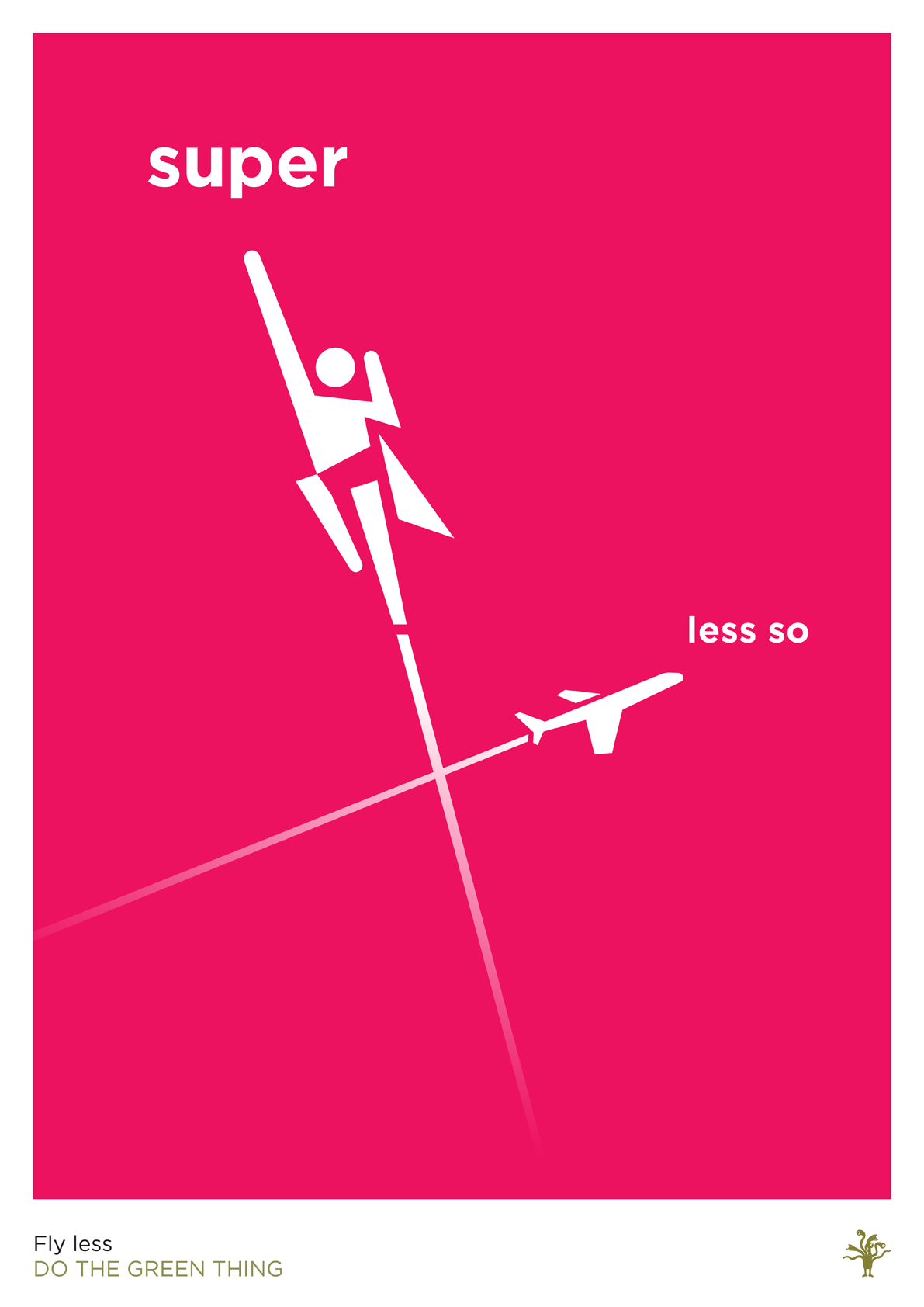
It's easy for the Man of Steel: Whenever he's tired of saving the world and needs to retreat to his Fortress of Solitude over on the North Pole, he simply takes off and flies there, on his own power. The rest of us are not superheroes, and for us travel to remote places means we need to board a bird of steel (or, more accurately, some aluminium alloy).


Poster by Hamlet Au Yeung for Do The Green Thing

You can't deny that airplane travel is fast, but it also has a huge carbon footprint. It is true that any given scheduled flight / train / bus will depart whether or not you bought a seat on it. This argument certainly holds for travel on Amtrak trains, which tend to have a low occupation (outside of big travel holidays like Thanksgiving). So the marginal carbon emissions - the emissions due to the extra person travelling on that half-empty train - is quite small.

But airlines have removed from their schedules those flights that tend to be half full, and consolidated them with other flights, so most airplanes are filled near capacity these days. This means that on the aggregate, the more of us are looking to fly a segment (say Boston to San Diego), the more flights the airline will schedule on that segment.

June 13, 2013

Review: Honda CR-V

Bucking the trend, the very popular Honda CR-V has not grown over the years: since its introduction in 1995, its size has stayed pretty much the same in the length and width directions, and it has actually become less tall, going from about 70 inches for the early SUV to 65 inches for today's crossover.

While in the early days it looked like a utilitarian box on wheels much like the old Jeep, the CR-V has gradually moved its image toward sophistication, to the point that the sides now resemble a Lexus SUV. (There's some poetic justice in this, since the earliest Lexus RX, in my humble opinion, resembled a pregnant Honda Civic: what goes around comes around).

June 12, 2013

Arctic Sea Ice Visualisations

Arctic sea ice is melting apace, and will soon leave a watery expanse where the earth used to show a white-capped north pole. The diminishing of sea ice at the polar region is already altering the jet stream and making extreme weather events more extreme and of longer duration. There is worrisome evidence of the spread of disease as temperatures are rising around the north pole.

The movie "Chasing Ice" gives a glimpse of the enormity of the melting of the vast Greenland ice sheet. When that ice sheet releases ice into the sea in the process of calving, it does so in chunks the size of Manhattan - only quite a bit taller. The scale of that ice sheet is hard to comprehend.

But the area covered (still, so far) by arctic sea ice is even larger than Greenland. And it looks like all that is melting away as well, at an ever increasing rate since the 1980s.

Andy Lee Robinson, who is at that rare cross-roads between geeky techno-savvy and highly creative artistic talent, has made a movie that shows the total volume of arctic ice as the years go by: basically we're witnessing the melting of a gigantic ice cube.

The graph shows all the data; but it doesn't hit you in the gut like the movie does. Make sure to have sound on.


Arctic Sea Ice minimum volume 1979-2012. (31 secs)

June 6, 2013

Green Is Frugal! Reducing Car Use and Meat Consumption

In a recent survey, readers of the Reduce Footprints blog said that the toughest challenges in green living are reducing the use of the car and reducing meat in our diet. I totally get that: Like with most people, my mouth starts to water when I catch the smell of a nice steak on the grill (why, even writing about it gets it going). And the car is so convenient. Besides, even if you tried you couldn't get away from it, since many of us live in suburbs or small towns where you don't get anything done (work, play, groceries) without a car.


Photo SpaceMonkey

But while biological imperative and the pressures exerted by an inherited infrastructure can be strong, that doesn't mean that we have to let go all the brakes and jump in our SUVs to drive to the nearest steakhouse. We can put up a resistance.

Ah, you say, the spirit is willing but the flesh is weak. I get that too: personally, I particularly shine at energy conservation when we're talking about physical energy that my body has to exert. On cold or rainy days that car really beckons to me.

So I need a motivation that's stronger than the objections my wily self can put up (and she is wily, my evil twin).